Harry Crews: Freak Show Writer

A boyhood year spent paralyzed and getting scalded in a kettle of boiling water must do strange things to the mind. Harry must have considered himself a freak. In fact, he would devote his career to writing about freaks. Maybe you’ve heard of Harry Eugene Crews. He came into this world June 7, 1935 in Alma, Georgia and he left it March 28, 2012 in Gainesville, Florida. This son of an indigent sharecropper in Bacon County ascended to writer in residence at the University of Florida. That’s more than remarkable. Were Crews alive, he’d be approaching his 81st year.

I first heard of Crews when he was a mere 44 years old. I worked in film at South Carolina Wildlife back in the 1980s. A biologist and graduate of the University of Georgia was telling me about Car, Crews’s 1972 novel where the main character, Herman Mack, commences to eat an entire Ford Maverick, while sitting in a window for all to see. Mack did this for a year, a little bit of the Maverick each day. Yeah, Crews created freaks. In The Knockout Artist Eugene Biggs takes advantage of his vulnerable jaw to knock himself out for pay. How can you forget characters like these?

Crews’s memoir, Childhood: Biography Of A Place got to me bad, and I often read excerpts to my writing students. They marveled at his language and experiences. See what I mean. About being scalded, he wrote, “I reached over and touched my right hand with my left, and the whole thing came off like a wet glove. I mean the skin on the top of the wrist and the back of my hand, along with the fingernails, all just turned loose and slid down to the ground. I could see my fingernails lying in the little puddle my flesh made on the ground in front of me.”

Some people find beauty in strange places. Crews was such a person. “There is something beautiful about scars of whatever nature,” he wrote in his novel Scar Lover. “A scar means the hurt is over, the wound is closed and healed, done with.”

Like many an afflicted soul, he longed to become a writer from an early age. Life stocked him with great material. He and childhood playmate, Willalee Bookatee, made up stories about the photographs in the Sears, Roebuck catalogue. Crews remembers the catalogue and in a way the catalogue made him who he is. “In the minds of most people, the Sears, Roebuck catalogue is a kind of low joke associated with outhouses. God knows the catalogue sometimes ended up in the outhouse, but more often it did not. All the farmers, black and white, kept dried corncobs beside their double-seated thrones, and the cobs served the purpose for which they were put there with all possible efficiency and comfort.

The Sears, Roebuck catalogue was much better used as a Wish Book, which it was called by the people out in the country, who would never be able to order anything out of it, but could at their leisure spend hours dreaming over.”

Crews heaps praise on the catalog. “The federal government ought to strike a medal for the Sears, Roebuck Company for sending all those catalogues to farming families, for bringing all that color and all that mystery and all that beauty into the lives of country people.”

The models in the catalogue were nothing like the people he knew though. Crews said he first became fascinated with the Sears catalogue because all the people in its pages were perfect.

“Nearly everybody I knew had something missing, a finger cut off, a toe split, an ear half-chewed away, an eye clouded with blindness from a glancing fence staple. And if they didn’t have something missing, they were carrying scars from barbed wire, or knives, or fishhooks. But the people in the catalogue had no such hurts. They were not only whole, they had all their arms and legs and eyes on their unscarred bodies, but they were also beautiful. Their legs were straight and their heads were never bald and on their faces were looks of happiness, even joy, looks that I never saw much in the faces of people around me.”

“Young as I was, though” wrote Crews, “I had known for a long time that it was all a lie. I knew that under those fancy clothes there had to be scars, there had to be swellings and boils of one kind or another because there was no other way to live in the world … And it was out of this knowledge that I first began to make up stories about the people I found in the catalogue.”

He joined the US Marines during the Korean War when he was just seventeen. Afterwards he took advantage of the GI Bill to educate himself. He biked across America on a Triumph motorcycle, worked as a bartender, short order cook, and a carnival barker where life among the freaks left a lasting impression upon him. I can’t speak for you but I find the following passage from Harry Crews to be as full of humanity as anything I have read.

“I was especially fond of the Fat Lady and her friends there under the tent. I think I know why, and I know when I started loving freaks. I had been able to rent a place to sleep from a freak man and his freak wife and I woke up one morning looking at both of them where they stood at the other end of their trailer in the kitchen. They stood perfectly still in the dim, yellow light, their backs to each other. I could not see their faces but I was close enough to hear them clearly when they spoke.

‘What’s for supper, darling?’ he said.

‘Franks and beans with a nice little salad,’ she said.

“I have never stopped remembering that as wondrous and special as those two people were, they were only talking about and looking forward to and needing precisely what all the rest of us talk about and look forward to and need.”

Harry Crews … one of a kind. Every now and then someone will ask me “Would you like to sit down and talk with who’s has gone over to the other side?” Aside from the obvious people, I’d like to have coffee or a drink with Harry Crews. He was a person for whom the mold worked just once before it cracked, suffering irreparable damage. With his leer and menacing aura he was the real intimidator. Add to that foreboding the haunting tattoo he was famous for, a tattoo of a skull beneath which was a line from E.E. Cummings’ “Buffalo Bill.”

“How do you like your blue-eyed boy, Mr. Death?”

Surely Harry Eugene Crews had blue eyes, this writer who came from nowhere and went somewhere. Now he’s gone to that freak show in the sky, and I suspect Mr. Death is having a hard time handling this unforgettable Georgian.

Granddad’s Cow-Charming ’65 Chevy

Car 3

Granddad Poland farmed but never drove a pickup, not that I recall. In a battered old car, he’d bump through pastures festooned with yellow bitter weeds, clunk past a lonely persimmon tree and ranks of white-faced cattle. Herefords, they were. From afar, those cows would amble Granddad’s way and when his jalopy closed in they would break into a stiff-kneed trot. To see the old man’s car was to see feed and hay.

My best friends, the children of field hands, and I sat in the back of Mr. Johnny’s cars. Sometimes we rode on the trunk, sometimes on the fenders. We were invincible and we were oblivious. The era of Jim Crow was upon us but Joe Boy, Sweetie, Jabe, and I knew nothing about all that. We were comrades in arms united in our quests to knock down red wasp nests, catch bluegills, dine on tomato-red persimmons, and swim in ponds sometimes blue, sometimes muddy. We lived like kings.

Granddad wore a felt hat and overalls and could cuss the horns off a billy goat. Whenever I was in his presence, I felt the need to hush up. Outside of cussing, Mr. Johnny didn’t talk much, so neither did I. And maybe that was good. For what I remember from our drives through pastures about lightning bug time pleases me still. The grassy hillsides … the fertile fragrance of pastures … the lowing of cattle … the distant line of dark trees it seemed an artist had sketched and fishponds smooth as glass where bullfrogs commenced to sing and fireflies lit up clumps of grass.

When the car shut down with a shudder and we sat still as stones, country sounds embraced us. Wind, lowing cattle, the distant hoot of a barred owl. Nary an ambulance, fire truck, or police siren. “Sigh-reen” as the country folk are wont to say. “Did y’all hear that sigh-reen last night?”

Most of what pleased me as a boy took place on that farm. And so I associate Granddad’s old cars with treasures—varnished cane poles, red-and-white bobbers, mats of algae that betrayed snakes’ serpentine wanderings, jelly-like clumps of frog eggs, and the heavy wooden boat Granddad made with its ever-present snakes beneath—treasures like no others. Grandmom taught me to dig worms from beneath cow piles. We marveled at a great pine of another epoch that served as a place to butcher cattle. We tread by it with reverence. That farm was our Disneyland adventure and Granddad’s old car carried us o’er its pastures, bottoms, and woodlands. We were kings in a kingdom where palatial treasures waited around the bend of every cow path.

When we were on foot, away from Granddad, we found mischief. There was a time when a western section of Granddad’s pasture looked like a junkyard. Old cars, old tractors, farm implements, and all manner of scrap metal gave red wasps places to hang their waxy papery nests, which we gleefully clobbered with flint rocks. The fun part? Running for your life when a boiling ball of mad wasps shot out.

I’d do it all again. All.

It’s a damn shame we grow up. By the time I was in college and too big for my britches, Granddad used a 1965 Chevrolet Bel Air as his truck. Green like copper patina it was. Like all the cars before, he fueled it up at his own pump. That pump stood between the house and the barn—all three gone now, relegated to the dustbin of history but this past Sunday I stood right where the old pump stood, a yard from where Great Uncle Searles tried to knife Dad one heated Sunday afternoon. You don’t forget things like that.

As for Granddad’s car, the only places it went were pastures, Dad’s saw shop, and Price’s Store, a classic country store with its roof now open to rain, soaking the very floors where Cokes still bob in ice-filled vats in one boy’s childhood memories. Granddad and Grandmom’s house burned two years ago. Someone tore down the old barn where a million fleas would hop on you, and Price’s Store is mortally wounded. Damn if everything we love doesn’t just rot away.

That car and some outbuildings are the only things left from my farm-exploring childhood. Granddad’s dead. Grandmom’s dead (All my life I called her “Bama,” the residue of childhood speech issues). The home place burned. My childhood friends are grown and gone and I have changed so much sometimes I don’t even know who I am anymore. And Granddad’s last car? I figured that car had long gone to the scrap pile. Granddad died in 1972, and I figured I’d never see that car again but I never forgot it.

And then lo and behold February 18, 2018 when I was walking his old farm taking pictures and recalling things, I couldn’t believe my eyes. There it was. His “Bel Air” pickup was sleeping in a sepulcher of cedars and vines, which had grown around it. Like a heart ripped from its body the old battery sits on the ground still. It’s there. See for yourself. I did. Gave me a jolt.

I guess we have come full circle. Granddad used a car for a pickup … Back in the dark ages when I was in high school you wouldn’t be caught dead in a pickup. Uncool. Then the Ford Ranchero came along in 1957 and not to be outdone Chevy’s El Camino debuted in 1959. Things began to change. Get feed and hay by weekday and go to church in your new pickup come Sundays, but pick up a date in one? No way. Well, somehow the pickup ascended. There’s a kid in my neighborhood who drives one. He’s souped it up and outfitted it with one of those annoying boom bass systems you hear for miles. You know and I know he’d never drive it across a terrace in a pasture full of manure … sun-baked cakes as Mom referred to them. Cows probably terrify him too.

As for Granddad’s cow-charming ’65 Chevy, he probably got it from one of his favorite haunts, a junkyard. Over a handful of years he made his last pasture rides in that car. And who went with him? I daresay no one other than Roosevelt, staunch friend of the family. The times, something called change, and a bad heart were about to leave Granddad in the dust. But his car is still with us. It sits there waiting for Joe Boy, Sweetie, Jabe, and me. Had I a time machine I’d see that we all take another ride through Mr. Johnny’s farm. We’d put a new battery in, get some tires and gas and head out. The things we’d talk about … riding through the pastures of long-lost youth and missing those white-faced cattle.

A Fondness For Old Gas Pumps

016 Gas Pump & Vines copy

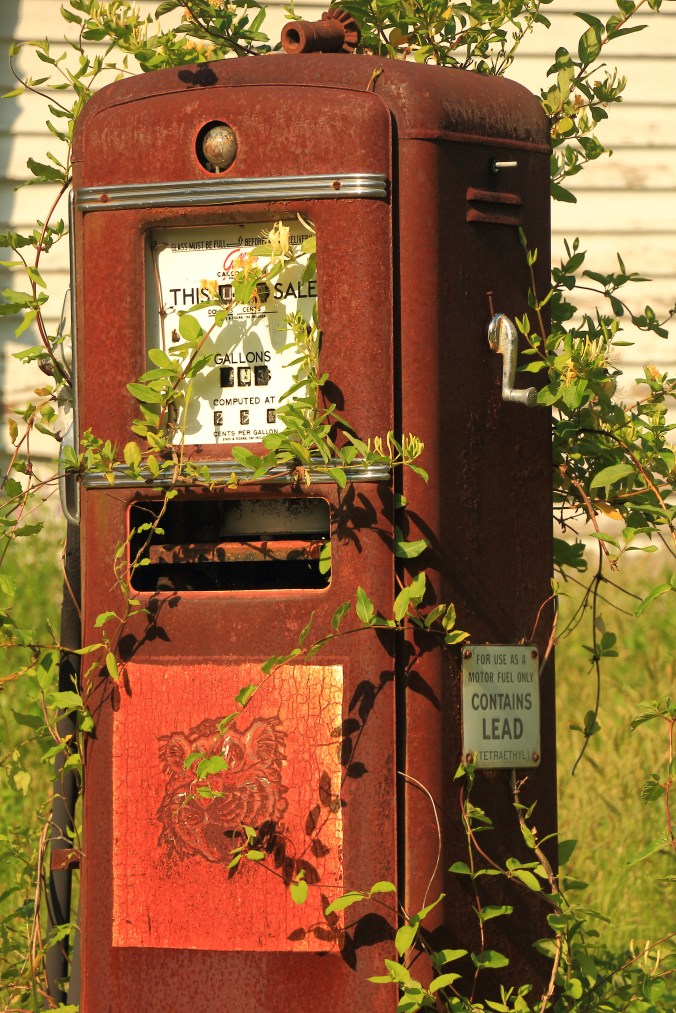
In the country, you’ll come across transportation veterans: old gas pumps. Something about them pleases me. I think of them as elder statesmen. When I see a proud old pump, its dispensing days behind it, I feel a tinge of sadness. It’s been put out to pasture.

I have a long history with gas pumps, and you do too. Ever wondered how many hours you’ve stood by a gas pump over the years? The answer is plenty. Ever worked at a place where one duty was to pump gas? I have.

My first job was at Goolsby’s store on Georgia Highway 47 bagging groceries, stocking shelves and pumping gas. I liked how the old pumps clicked off increments as gasoline flowed into cars and trucks. I liked, too, the glass bubbles where gas swirled around. “Glass must be full before delivery.” And who can forget the old pumps with glass globes. Old pumps amount to works of art. I’ve had a fondness for old gas pumps ever since.

Only once did pumping gas concern me. Down at Goolsby’s Store, I pumped regular into a car whose owner wanted “high test.” The way he reacted to receiving regular made me think I had mixed nitro and glycerin and his car would explode when he started it up. Of course, all was fine.

093 Old Gas PumpBack in my early years of driving, an old pump often got the last dollar I had. I got my money’s worth though. A dollar’s worth of gas would keep me rolling a long while. Not so today. Today’s gas prices vary wildly from day to day, and any excuse is justification for shooting up the price nineteen cents a gallon overnight. Back before all this global concern shifted logic upside down, the old pumps were stalwarts of stability. Not so anymore.

No matter the price of gas, you must admit that gas pumps serve an indispensable role in life. We can’t get very far in our mobile society without them. Having said that, let me add that I don’t care for the modern digital pumps that put on the breaks [brakes] as you near the end of your purchase. The last gallon takes as long as the previous five. And most of all, I absolutely detest the pumps where an ad plays as you fill your vehicle. Mute them.

The old pumps had class. They weren’t half pump and half robotic salesman. My Granddad Poland had a stately old pump down on his farm. It provided the fuel that his tractors, trucks and cars needed. It’s been gone for decades, but I can lead you right to the spot where it stood. That pump and a few others fuel my interest in abandoned stores and old farms. To this day, when I spot a lone pump at a shuttered country store or what was once a farm, I try to get close and read the price of gas per gallon off those old dials.

In Mount Carmel, you’ll find an old pump that has gas at exactly twenty-five cents per gallon. I like this old pump a lot. I even like the warning that it contains lead; that was to keep cars from knocking. I like the old Esso tiger on the front. “Put a tiger in your tank.” Remember that? Of course, Esso became Exxon. Once known as Standard Oil (“SO,” see?), Esso changed its name to Exxon when other Standard Oil spinoffs complained about the use of Esso.

Stopping to check out an old gas pump can lead to interesting tales too. I discovered a story in Edgefield County about a mule kick that killed eight people because I stopped to photograph an old gas pump. I’ll share the introduction.

Edgefield StoreYou can drive by a place a thousand times and be unaware of its history. Such was the case for a small country store on Highway 378 in Edgefield County. Over the years, I’ve passed the little store plenty of times and not once did I stop. That changed Sunday, October 13. I did pass it, but I turned around and went back, curious to see what the price of gas was on the old rusty pump.

I got out with my camera, and a classic RC Cola sign immediately distracted me. Behind it was another vintage sign advertising Camel Cigarettes. American Pickers would like this place, I thought. I moved closer to get a good shot. That’s when a man slipped up behind me.

“If you think I’m selling those signs you’re wrong.”

Startled, I said, “No, I just wanted to photograph the old gas pump and the signs caught my attention.”

“People try to buy them all the time.”

“It’s a wonder someone hasn’t stolen them,” I replied.

“Maybe I’ll file off the nail heads,” he said and then he paused. “My granddad got killed in that store.”

“Robbed and shot?”

“No, a woman had him killed for $500.”

And then the most incredible story unfolded, a story that goes back to 1941. The little store at the intersection of Highway 378 and Highway 430, a road that leads to Edgefield, a road known as Meeting Street, holds deep, dark secrets.

It’s unlikely I’d have stumbled onto that story had I not stopped to photograph the pump at the old Timmerman store. Like the pump in Mount Carmel, the Edgefield country store pump was rusty red.

I like this old pump, too, because the penetrating smell of gasoline has given away to the sweet smell of honeysuckle. Every now and then, as I ferry across the Savannah, I detour off Highway 378 to check on this Mount Carmel survivor. I expect it to continue to age gracefully, and I expect the honeysuckle to encase this veteran of another era in green and yellow as springs come and go.

Wall Dogs & Ghost Signs

_MG_1440


They Beautifully Preserved The Past

Like dogs with a penchant for roaming, they chained themselves to a wall. Tethered to brick walls above the ground with a brush and bucket of paint in their hands, these daring artists had a mission. Paint an advertisement onto the side of a building. They called themselves wall dogs and some claimed they worked like dogs. I suspect they loved their work and I am certain wall dogs’ ghost signs make our world more mysterious, more beautiful.

You’ve seen ghost signs, an old-fashioned advertisement painted onto a rough and unforgiving canvas, a brick wall. Ghost signs hawked products and businesses that no longer exist, Coca Cola being an exception. The products and businesses they peddled possessed names as colorful as they were in their prime. Owl Cigars. Old Reliable Bruton’s Snuff. The Creamery Café. King Midas Flour. Can’t Bust ’Em Overalls. Uneeda Biscuit. Ballarat Bitter. Made by Cows Milk, Mother’s Bread 100% Pure, and Nightly Bile Beans. Some ads shone a harsh light on the times such as Clark’s Café All White Staff. Exuberant American capitalism some called these ads.

You’ll see rejuvenated ghost signs, some having been preserved for nostalgic reasons. Others continue to fade, a ghostly reminder of the past. Original creators of these vintage ads, works of art, left us long ago. Their work, however, lives on.

Once upon a time, wall advertising was all the rage. Many ghost signs went up in the late 1800s on up to the Great Depression and into the 1960s. Most buildings sported commercials. Advertisements painted directly onto brick buildings brought colorful messages to people in cities, towns, and villages across the country. Zoning and changes such as advertising on billboards led to painted brick advertisements’ demise, but many survive, paint flaking away yet clinging nonetheless to the walls that have long given them a home. Lead-based house paint grips brick with tenacity but relentless sunlight and the elements conspire to fade them. Demolitions to make way for the rise of sparkling but character-starved edifices have robbed us of many ghost signs. When you come across a ghost sign, I advise you to photograph it.

Vintage sign painters were skilled artists and generally worked for one of the major sign companies. They roamed from town to town and lived an eccentric lifestyle. Owners of walls often got a perk, a smaller ad for their own business above or below the main ad. The painters mixed their own paints to exacting colors. Wall dogs used scaled drawings to transfer their designs to walls, making sure the lettering was level, often the wall wasn’t, and they saw that all elements filled the space as planned. Their exacting work survives in the hinterlands and cities but something about small towns and ghost signs go together. When I journey through a town with a sprinkling of stoplights I expect to see ghost signs and more often than not I do. Bleached by sunlight and washed by rains, they do indeed look ghostly, a pale rendition of their former glory. I see, too, new murals designed to give a town a tourism boost. Don’t confuse those with ghost signs. Freshly painted ads on buildings lack authenticity. Real deal signs often promoted patent medicines, tobacco, and beer.

We live in the era of garish digital billboards and that gives me a craving for old ghost signs. Fortunately, modern wall dogs carry on the tradition of painting on buildings and they do so in a traditional way including the paints they use and the way they mix them. Suspended on a platform hooked to a pulley system, they work ten to twelve hours at a time. They use levels, brushes, sketches, and wear safety harnesses in their airy studio on high. They face challenges. Scale, delicate lettering, the fear of dripping paint on someone, and that thing called gravity. You could say the work has its ups and downs. It’s risky. They only get to break the law of gravity once.

Just once I’d love to drive into a small town, one with one stoplight at the junction of dusty country roads and enter a Twilight Zone-like time warp that transports me to the past. I’d like to see a Norman Rockwellesque setting where a wall dog is standing on a platform painting a hardware store’s wall of old brick. He reaches down, gets his paint-splattered level, and makes a mark. Here is where the words will go. Ever so carefully he makes a white “B” and then a “U.” When he is done, a genuine Bull Durham ad glistens on the brick like new fallen snow. He lowers himself to the ground and admires his work. Then it’s time to load up and travel to the next town. In the decades to come his Bull Durham ad will age, crack, flake away, and fade. Like a weathered face, it’ll possess character. And our wall dog? All that lead paint did him no favors. He’ll move to a place called Obscurity and die.

Wall dogs did their thing, never meaning to leave latter-day folks picturesque ads. They sought highly visible locations from which their art could solicit business and up went their form of art. For those of us who love nostalgia, we owe wall dogs, a different breed of artist, a big thank you. And ghost signs? Consider them a window to the past.

Connected By Oystering

Two Georgia Artists—A Photographer and Writer

Mists veil a dock house. Its weathered pilings look like a comb with teeth broken out. On a spit of land sat an old oyster house. Gone. Nothing left. Unassuming workboats sit empty. An abandoned bateau sits in a fringe of marsh.

Oystering.

Dragging a chain across the bottom until it jerks hard.

Tongs and rakes.

Bateaux with rough irregular shells piled up high. Like a heap of gray rocks. Oystermen in three bateaux materialize from fog at dawn. In buffed gold mists, four men—two sitting, two standing—ignore each other, intent on work, steel rods in their hand. Engines tilted up, the boats moored, they work. A steel rod breaks a clump of oysters loose. A pocketknife comes out. An oyster goes down.

A white concrete block seafood shop with “Oysters” painted by hand on its window. Closed now for good.

Steamy smoke fragrant as sea salt. Raw, steamed, fried, smoked, canned, in tins with peel-back lids, grilled. In a shot glass with cocktail sauce, lemon, horseradish, and vodka. In gunnysacks. Mounded over hot tin, steaming. Pushed into smokers. Shells opening just so of their own accord. Shiny knives flashing in Lowcountry light. Gray oyster banks destined to become snow-white stones crushed beneath tires.

These images, emerging from a mist all their own, surfaced when I read Ellen Malphrus’s “On the Wings of the Incoming Tide,” her paean to Pat Conroy and nod to James Dickey’s “Starry Place Between the Antlers, Why I Live in South Carolina,” which I have among my letters. First published in Esquire magazine in 1981, Dickey wrote, in part, of an albino deer swimming beneath moonlight between islands and of the Lowcountry and its food. “The food is wonderful and unique: she-crab soup, red rice, shrimp or oyster pilau, Hoppin’ John, chicken bog. While I am there I am living proof-positive of John Peale Bishop’s dictum that the true test of a civilization is an indigenous cookery.”

I knew he had written about oysters, that noble bivalve mollusk. That delicacy. And I knew he had written it for a fellow Georgian. Images of half shells as white as pearls and a white buck swimming in moonlight belonged together, both marinated in brine as it were.

Some of you know I am a graduate of the University of Georgia. I studied Journalism there. While I was there, a man named Jack Leigh was there also. Leigh is the man who took the photo of “Bird Girl,” the cover of John Berendt’s Midnight in the Garden of Good and Evil. A cover like no other, it’s mysterious and foreboding, but forget that. Leigh was an acclaimed photographer long before Bird Girl came along.

Leigh and I may have taken courses together at the Grady School of Journalism but we never met. We would share, however, a connection down the road. James Dickey would write the foreword for Leigh’s Oystering, A Way of Life, just as he would write the foreword for South Carolina, The Natural Heritage, a book by Robert Clark, Steve Bennett, and me.

Like Ellen and me, Jack Leigh read Dickey’s “Starry Place Between the Antlers.” That set him to thinking. “Might James Dickey write the foreword for my book on oystering?” Back then we lived in the era of the letter, banished today by email, except for the more refined who walk among us. Leigh wrote Dickey and in two days the poet responded. The two Georgians began a period of collaboration.

Dickey had a keen interest in photography and with great pleasure he looked at Leigh’s work. About Leigh’s oystermen wrote Dickey, “the last of these, surely.” His words were both a prophecy and poetic tribute. “They are not fishermen; they never feel the run of any line. The electric vibration of an unknown body, or the mingling of the seine, but instead lean down—walk and lean down—like parts of walls, over the soft paving of mud, as their families and blood have caused them to do …”

Two Georgians connected by oysters. Both artists, both gone now, just as much of oystering seems determined to leave us as it wallows in the wake of something called progress. For those who cherish oysters and their willingness to sacrifice themselves for our pleasure, it’s time to send up a prayer, a time to recall the plea from Dickey’s last line in “The Last Wolverine.” “Lord, let me die, but not die out.”

Amen.

A Country Club Like No Other

Harolds Signage WideDown near Yemassee is a country club like no other. Harold’s Country Club proclaims that it is “in the middle of nowhere but close to everywhere.” That’s true. You’ll find it off Highway 21 at 97 Highway, 17A. I did when I pulled up in front of a faded sign that’s seen its share of Lowcountry sunlight. Nonetheless it’s colorful. A grill full of ribs, chicken, and a huge steak fill one side, a frosty mug of beer the other, and in the middle a graphic: a circle around a bespectacled Harold and words: “Harold’s Country Club … Bar & Grille, Est. 1973.” The likeness of Harold Peeples looks like a sheriff from a tough county in South Georgia.

Gas Pump CornerAt the right, front corner of the building stands an old Fire Chief gas pump. Gives the place character. I walked up to the front glass door with a sky blue paper note stuck to the glass: “Benton’s Fresh Boiled Peanuts.” You could smell salt in the air.

As I stepped inside rules caught my eye. “You are required to pay for every steak you order.” “Please clear table.” In the poolroom, a list served notice that improper behavior would not be tolerated. “No Smoking.” “No Hitting Sticks On Tables.” “No Sitting On Pool Tables.” And then in lowercase: “follow the rules or you will be barred from playing pool.” Over near the bar some advice: “Win or lose, stick with booze.”

Bar PatronsLocals heeded that advice. At 3:30 in the afternoon a cast of characters sat around the bar. “Like a scene from Andy of Mayberry,” I mused. On the flatscreen at the bar’s end a NASCAR race was underway. No one paid it any mind. At the bar’s opposite end, a giant plastic parrot on a perch watched the race. Well, it appeared to.

Legs PosterHarold’s is family friendly. That doesn’t preclude a poster in the poolroom of a woman with fabulous legs promoting a vampire movie, Bordello of Blood “Where customers come in, but they don’t come out.”

Well, no worries, you’ll come out of Harold’s Country Club in good shape but know that when you walk in you are stepping in high cotton. A touch of fame attends this venerable old way station. Celebrities have trod here. Harold left us in 2003 but in his day he had a special friendship with movie producer Joel Silver who owns nearby Auldbrass Plantation of Frank Lloyd Wright fame. Joel often stopped by on Sundays to have coffee with Harold.

In 1994, Dennis Hopper transformed Harold’s into a biker’s bar for his movie, Chasers. Coastal Living, Esquire, and Southern Living magazines have all covered Harold’s. Garden & Gun called it one of the best dive bars in the South.

What would become Harold’s Country Cub began in the 1930s as a Chevrolet dealership. Harold Peeples bought what had become a garage and gas station in 1973. In the late 1970s, friends and neighbors began gathering for covered dish suppers on Thursday nights. Over time the group began cooking and eating in the garage to avoid bad weather and infamous Lowcountry gnats and mosquitoes. As gatherings grew, Harold took over the cooking, charging a small amount to cover expenses.

Today, every Thursday features a different meal. Fridays feature “wings and things” and seafood and fish and chicken and steaks and hamburger baskets and extras such as jalapeno poppers, fries, fried mushrooms, hush puppies, onion rings, and more. Saturday nights usher in 12 to 14-ounce choice cut ribeyes. Meals include baked potato, sautéed onions, salad, and roll. Yes, dive right in.

How Harold’s became an eatery is a tale worth telling. In earlier days folks moved cars out of the garage to set up tables and chairs. In time, the cars left for good. The garage’s lube rack is now a “stage” seating area commandeered at times for live music. (Harold built that stage over the “grease rack.” How cool it’d be to see that rack rise with a country band on stage, a platform like no other.)

Harolds WallAs the garage evolved into a bar and restaurant, radiator hoses and fan belts stayed put. Gave the walls atmosphere. On May 9, 1999, a fire destroyed the entire bar area, hoses, belts, and all. Harold rebuilt. Friends donated artifacts to help restore the unique décor. A room for extra seating and private parties morphed into the bar, and Harold’s was up and running within a week though two weeks passed before meals could be prepared. Missing the first Thursday potluck proved to be too much. Customers asked Harold if they could bring covered dishes. The food was back and the rest, as they say, is history.

But wait. Hold on. We have one more fish to fry.

What about that name, Harold’s Country Club? Well, a tale’s behind that too. Harold devoted much of his time to baseball and softball. He played, coached, umpired, and supported the local softball team. When that team needed a place to play, Harold and friends formed the Yemassee Athletic Association. They bought land and built a ball field across the road beside what today is the Country Club, known then as Peeples Service Station. After games ended, announcer Charles Jackson had a custom of saying, “Now, let’s all go over to Harold’s Country Club for a cool one.” Soon people started calling the business Harold’s Country Club.

Pay For Your SteakHarold, despite all his rules, had a heart. Rich or poor, he treated folks the same. He had a reputation for helping friends, strangers, and stranded motorists, whoever. He valued good times and wanted everyone to have just that. A good time. But then there were all those rules. He didn’t accommodate tomfoolery. In fact, he banned troublemakers from his old Chevy dealership “for life and a day.”

Folks that sounds a lot like forever, but it wasn’t true. A sincere apology got offenders back through the door. And you know they had to be grateful to be reinstated at Harold’s Country Club down yonder “in the middle of nowhere.” Down yonder where winds stream Spanish moss back like an older woman’s tresses and old oaks tremble when winds stir limbs heavy with resurrection ferns. Down yonder in Spanish Moss Land where a Saturday night carries the aroma of grilling steaks and locals talk about movie stars, old cars, and rules. Lots of rules.

See Rock City

Rock City 1 copy 2


In Mom’s back yard stands a red and black birdhouse on a white pole. Its roof holds iconic words. “See Rock City.” If it had not been for Garnet Carter and Clark Byers, that birdhouse wouldn’t exist, for that birdhouse harkens back to a heralded part of Southern lore. Times were, you could drive along a back road and sooner or later you’d see a barn with its roof turned into an advertisement.

You’ll be hard pressed today to find a classic barn’s roof declaring “See 7 States from Rock City. Near Chattanooga Tenn.” In case you’ve never heard of it, Rock City is a roadside attraction on Lookout Mountain in Lookout Mountain, Georgia. Chattanooga is close by. Gigantic rock formations, gardens, a Lovers Leap, and caverns with black lights I recall. I remember, too, Ruby Falls but that is an attraction inside Lookout Mountain. (No one’s ever proved you can see seven states from Lookout Mountain.)

I saw Rock City as a boy but I can’t recall ever seeing a Rock City barn. Monday, October 16, I did. The barn you see here stands on Highway 28 between McCormick and Abbeville, South Carolina. All these years it was close by. Surely I must have seen it at some point. Just can’t recall it. I’m sure of one thing, though. Photographers and artists captured the old barn’s likeness. Weathered with boards missing and gaping holes here and there, the proud old barn stands as an art museum, a survivor.

A fellow by the name of Clark Byers climbed atop it. Byers’s barn-painting career started in 1935 when Rock City founder Garnet Carter turned some country barns into Rock City billboards of sorts. He found a receptive audience in depression-weary Americans who were ready to hit the roads and see the land. An ad on a barn’s rooftop had to be an eye-catching proposition.

All this barn roof-painting business came about as a way to market Carter’s public attraction. Rock City officially opened May 21, 1932. Soon after, Carter enlisted the help of a young sign painter from Trenton, Georgia. He hired Clark Byers to travel the nation’s highways and paint three simple words on barns: “See Rock City.” Byers, who looked a bit like James Dickey, painted the words freehand and the size of the barn determined the message. The bigger the barn, the longer the message. The distinctive black-and-white signs appeared as far north as Michigan and as far west as Texas. Rock City gave the farmers $3 or free passes to Rock City and in some cases Rock City thermometers and bathmats in exchange for turning their barn roofs into ads.

Before he turned to painting barns, Byers worked in a cotton mill and bottled buttermilk for $3 a week. He would go on to paint barns for three decades, dodging bulls, clinging to slippery roofs, and watching the horizon for thunderstorms. He retired in 1969 after nearly being electrocuted by a lightning bolt while repainting a barn. He had painted approximately 900 barns in nineteen states. Byers died in 2004. He was 89.

Weather and time and something nefarious robbed us of Byers’s work, although I hear a few successors to Clark Byers still paint barns. That’s fine but they aren’t the real deal. Many vintage Rock City barns suffered a needless fate thanks to the scourge known as politicians. If they’re not renaming lakes, putting their names on highways, and in general throwing history into the trash can, politicians find ways to destroy beauty in the name of bureaucracy. Today many reminders of days when families hit the road for family fun and togetherness are gone. Ladybird Johnson, you may recall, latched onto highway beautification as her First Lady claim to fame. During her highway beautification movement, roadside signs were deemed an eyesore. The “Ladybird Act” meant that many Rock City’s rooftop messages had to be painted over.

As for Mom’s Rock City birdhouse, like many a Rock City barn, its best days are behind it. Neglect and decay make for formidable allies whether you’re an aged barn or a souvenir from Pigeon Forge, Tennessee.

I saw Rock City as a boy and now what seems 100 years later I can lay claim to seeing a Rock City barn. You can too. An online map of surviving Rock City barns directs you to these survivors (www.seerockcity.com). Georgia has five. South Carolina has one, and I saw it on Highway 28 four miles from Abbeville.

If I could turn back the hands of time, here’s what I would have liked to have seen eons ago. We’re on a family trip with Mom and Dad in an aqua-and-white 1956 Plymouth. Along Highway 28 we look to the left and see a new barn with a man on its roof. There’s Clark Byers sketching out his letters. Dad honks the horn and he turns and waves. He returns to work, using chalk to outline his message. “See 7 States from Rock City. Near Chattanooga Tenn.” We have no idea that we just witnessed history in the making but some sixty years later I would see what’s left of Clark Byers’s work, a ghostly, fading reminder of times past.


Quitting Time

No guts, no glory they say, and it is true. If you’ve ever taken a job and realized right off it was a mistake but stayed anyway, this column is for you. If you wished you had had the courage to quit that first day, then this column really is for you. Well, some folks do quit day one. Here’s a tale about a fellow you can’t help but admire. You just want to put yourself in his shoes.

I came by this courageous tale thanks to friend and reader, Warren McInnis Hughes, who told me a story reporter Bert Lunan liked to tell. “Like us,” said Warren, “Lunan was a restless wanderer.” Lunan, who worked two stints at Columbia’s The State, “had a great story he swore was true,” said Hughes, who’s a lady. Don’t let the name, Warren, fool you.

It’s a life lesson for sure that Warren shared. Lunan called his story, “Knowing when to fold ’em,” and it made him and his tale immortal. “I tell it to this day,” said Hughes. Indeed, she does. Lunan was working for a newspaper in Kentucky when a new reporter with a fine reputation came in for his first day. The new reporter spent some time in the newsroom and then made the rounds of his new beat. He came back in the late afternoon of his first day and said, “Well, that’s it. I’m leaving.”

“When will you be back,” asked a colleague.

“I won’t. I’m quitting.”

“Quitting? Why?”

“I just don’t like the feel of the place.” (Some of you know exactly what he felt.)

Lunan would wrap up his story saying, “See, the important thing is, “you got to know when to fold ’em. Not later, immediately.”

As Kenny Roger sang, knowing when to fold ’em is sound advice, and I commend this courageous and honest reporter for quitting on his first day of work. It’s something I should have done. Call it quits on the very first day, and more than once. I’ve quit four jobs and in two instances I just walked out the door. No notice, nothing. Just cleaned out my desk and walked. It felt great I assure you. Was it reckless? Sure. Was it necessary? Yes. What good is a job if it drives you crazy? And here’s the best part. Not only did I survive, I ended up in much better circumstances. So much for burning bridges. Lunan, you see, was right. “You got to know when to fold ’em.”

I folded them in one case when I was hired to be a writer when all the boss man needed was a dolt to follow him around taking notes. I folded them when a big boss man hired me as a writer when in reality all I did was edit technical reports all day long. “You hired a jet pilot to be a crop duster,” I told him. Technically he and his underling replaced me with a lawyer “who could write.” I felt like Brer Rabbit who had just been tossed into a briar patch. Ecstatic. I cleaned out my desk the next morning at dawn and vamoosed, never to be seen again.

In another situation I was hired to write web content except there was one problem. There was no web content to write. This job, in the early days of the Internet, was ahead of its time but nonetheless a bad fit for me. I hung in there ten months. Ten months too long. The very first day I should have said, “Well, that’s it. I’m leaving.”

In one instance that got pretty heated, I got tired of working for a drone with the intelligence of a dung beetle. He sicked his lieutenant on me and after a lot of harassment I just walked out. But, I should have left much earlier. Like a carton of old greenish sour cream, a job really does sour and that’s when you know it’s time to leave.

It’s been said there are worse things than having no income, and I agree. How many people do you know who have toiled away at a job they hate just to earn a paycheck. Now doing what it takes to support a family is noble, and I applaud that. But I know and you know that sometimes we hang onto a job because it’s just easier than finding a better one. Never a good thing.

Quitting time. It can apply to bad relationships, bad lifestyles (smokers), and even the places where we live. “You just don’t like the feel of the place.” It worked for that fine reporter and I’ll wager it can work for you too.

Moonshine Memories & Spirits

Moonshine 1

In the riverbed between Edgefield County, South Carolina, and Lincoln County, Georgia, a copper still sleeps in the ooze gluing two states together. That still belonged to my grandfather.

Every family—some will admit it—shuns some relative from its past. Growing up, I heard shadowy references to my grandfather’s past. He wasn’t the clichéd kindly old grandfather. We did few things together, save drive up cattle come lightning bug time, he calling them through cupped hands with a word I can only approximate as “quoey.” To this day he remains an enigma, the man who fathered my father but otherwise moved through my life unknown, a silhouette on a scrim.

He had linguistic talent. He was the “finest cusser” in the county as one gray-headed field hand told me and he had a wandering eye. My grandmother, having caught wind of his assignations, lowered a 12-gauge shotgun on him. He leaped the banister of a 15-foot porch and hit the ground running as a load of #8 birdshot flew over his head. He didn’t come back for four days.

I best see him chopping hog meat with a hatchet on a thick oak table. Each chop cut slightly past and across the last yielding a fine crosshatched layer of BBQ. He wore overalls, a felt hat as men did in his day, and in winter a brown leather jacket. He had money but you wouldn’t have known it. I don’t recall him ever buying a new car. He owned a large farm with eleven fishponds that infused my boyhood with bream-bed joy. He raised white-faced cattle and grew cotton, and light green watermelons run over with dark green, zigzagged stripes. In the summer he girdled oaks and in winter felled the dried-out trees and burnt yellow logs with red hearts in a black wood stove. The fragrant wood smelled sweet and sour at the same time. He would spit at the stove with its cherry-red stovepipe, each glob of phlegm landing with a hiss. When one landed atop the stove it rolled around sibilating like a ball bearing from Hell.

At its zenith, his farm sprawled across 5,000 acres along the Georgia side of the Savannah River. That was before the US Army Corps of Engineers built Clark Hill Dam, penning up the mighty Savannah and inundating more red clay than it projected. In short, the federal government stole 1,000 acres of fully timbered land from my grandfather for $1 an acre. Maybe that was the government’s way of extracting revenge from Mr. Johnny, as grandfather was known, for Mr. Johnny, you see, made moonshine.


My grandfather was eighteen when Prohibition arrived. He was thirty-one when Prohibition and its documented ills ended, proving that the road to hell is, indeed, paved with good intentions. During those years of parched throats Mr. Johnny perfected his moonshine, “the best liquor in the county” as one farmhand told me. He didn’t kill or blind people by using radiators and lead solder. He made quality white lightning and parlayed corn liquor into land. Otherwise, I know little about the man and his black market Prohibition days. One tale, however, made it through family censors.

Granddad and his charismatic brother, Thomas Carey, “Carey,” who sashayed around with two women on his arm, were working a still by the Savannah River. Perhaps they stayed in one spot too long. Maybe some fellow jealous of Carey ratted them out. Perchance the revenuers saw smoke. However they found his still, they raided it while Granddad alone was working it. Granddad broke and ran through briars and brambles, through thorns and thickets, through woods, and over barbed wire and when he could run no more and had lost every stitch of clothing, they caught him.

The agents escorted him, naked as the proverbial jaybird, home where my grandmother met them on the front porch. With an agent holding him by each elbow, Granddad spoke. “Thelma, I have to do some business for a few days in Augusta with these gentlemen. I’ll be back.”

Word of the raid got back to Carey. Women loved him. His sister, Nanny, said, “That Carey. He always had dolls.” Carey partied a lot and after a night of revelry he got ill. A doctor’s injection reacted with the alcohol … so the family believed, and at the age of 37 he was no more.

I like to think that Carey loved my grandfather very much, and I will write here that he did. Carey, hearing of his older brother’s plight, gathered up some farmhands and put the still, barrels, and all on a barge. They poled it to the middle of the Savannah and sunk it. When the revenuers returned to get their evidence there was none. They freed Granddad.

Down here moonshine put some jingle in pockets, food on the table, and in Granddad’s case land on the courthouse tax rolls. I’m not sure but I believe he ended his days of shine after his brush with the law and turned to full-time farming.

Were he alive today he’d be 113. Were he younger and alive today things would be different for dear old granddad. Thanks to recent micro-distillery laws it’s legal to distill liquor as an individual. You pay taxes on it, of course. Granddad could set up shop and make some shine with no worries about running naked through the woods. He’d have a plethora of regulations and requirements to meet but his experience with the government would serve him well.

As for Granddad, suffering chest pains on a Sunday evening, he died July 23, 1972, sitting in his car. Thelma had driven him to the little clinic where a doctor was substituting for the county’s vacationing physician. “Yeah, you’re having a heart attack,” said the substitute. “Get to the hospital,” and with that he went back inside.

There was no hospital.

Granddad died on the spot, done in by years of homegrown steaks, eggs, and bacon. That night I tried to comfort my grandmother who gruffly retorted, “Go on. I’ll be all right.”

Moonshine money and missionaries make a good mix. At Granddad’s funeral it surfaced that he had long donated a lot of money to his church, though he never attended. Field hands, however, did attend his service, the first time to my knowledge the little Baptist church down by the creek was integrated.

As for granddad, well, my mother never said one good thing about him, but the moonshine money that bought the land my late father inherited and sold sustains her. No complaints about that.

September 4, 1972, forty-three days after Granddad passed, my daughter, Beth, came into this world in the little clinic 30 feet from where Granddad sought salvation of another kind. As the Russian proverb goes, “One wedge knocks out another.”

Beth never speaks of her great-grandfather’s fine heritage but she probably knows more about him than anyone. Her spirit followed his not far from the mighty Savannah, family keeper of moonshine memories, and spirits have ways of communing what we mortals cannot.

My Father’s Canteen

The canteen hung from a nail on a roof support in my parent’s attic for decades. My father brought it home from Hiroshima. Somewhere through the years the canvas cover got lost. He brought back, too, Earth Superior binoculars and a Japanese rifle and bayonet. The rifle is missing. Only its bayonet remains. War relics.

This World War II canteen has the designation U.S. A.G. M. Co. 1942 on it. A.G. M. stood for the Aluminum Goods Manufacturing Company. Check eBay and you’ll see that a good many are for sale. Folks are selling history. Selling war relics.

Dad never mentioned this canteen and I don’t recall ever seeing it growing up. It must have been in the attic, in a dark spot, patiently hanging on that nail … waiting for someone to discover it. I brought it home thinking that it was my old Scout canteen. Then I learned that it was a World War II canteen. It’s been dry a long time. Seventy-two years or more.

The bayonet is a Type 30 bayonet designed for the Imperial Japanese Army. I see they are on sale on eBay too. As for the Earth Superior binoculars, I assume they are just an old pair Dad came by in the 1940s. They don’t appear to be Government Issue. A little research reveals they look more like Jumelle Duchess binoculars, with the French word, “Jumelle,” meaning opera glasses. Most were made in Paris. I doubt you’d find those in a foxhole. How Dad came by them is a mystery.

A lot of people metal detect old battlegrounds hoping to find war relics. Maybe they should check the attics and basements of their fathers’ home. Men must carry things in wartime. Soldiers must carry canteens, guns, bayonets, and helmets. And they bring these things and more home. Dad brought back silk flags, relics of his time in Japan. As a boy I’d unfold them, a rising sun with spectacular rays burst off the alabaster silk as if afire. Japan—Land of the Rising Sun. My father brought memories of Hiroshima home but he never discussed them. And the flags? Gone. Lost by me.

About seven years ago, the sister of a student of mine, gave me a book, The Things They Carried, written by Tim O’Brien. After graduating from college in 1968, O’Brien received a draft notice. He reported for service and went to Vietnam. O’Brien would go on to be a reporter and then an author.

In The Things They Carried, he takes us into the soldiers’ combat lives in unforgettable ways. In a dry, matter-of-fact style he creates powerful images. “The things they carried were largely determined by necessity. Among the necessities or near-necessities were P-38 can openers, pocket knives, heat tabs, wristwatches, dog tags, mosquito repellent, chewing gum, candy, cigarettes, salt tablets, packets of Kool-Aid, lighters, matches, sewing kits, Military Payment Certificates, C rations, and two or three canteens of water.”

O’Brien wrote of the personal things men carried, too. “Ted Lavender, who was scared, carried tranquilizers until he was shot in the head outside the village of Than Khe in mid-April. By necessity, and because it was SOP, they all carried steel helmets that weighed 5 pounds including the liner and camouflage cover. They carried the standard fatigue jackets and trousers. Very few carried underwear. Until he was shot, Ted Lavender carried 6 or 7 ounces of premium dope, which for him was a necessity.”

O’Brien wrote, too, that, “They carried the sky. The whole atmosphere, they carried it, the humidity, the monsoons, the stink of fungus and decay, all of it, they carried gravity.”

I can only guess what Dad carried in his head in Japan. He served in U.S. Army Ordnance and spent time in Yokohama but he also went to Hiroshima just after the Enola Gay dropped “Little Boy.” And he went to Nagasaki. There in the land of geishas and samurai, he might as well have been walking on the surface of the sun. He was at most, 19 or 20. The things he must have seen as he tread Hiroshima and Nagasaki’s toxic soil. There was no way he could avoid horrors. Skinless people. Men with stripes burnt onto their skin. They were wearing striped shirts when the brilliant flash hit them, the nuclear burst that stenciled dress patterns onto women’s bodies. Dad never talked about things like that, but he carried them.

He returned to Georgia with evidence of his Hiroshima days: a canteen, a rifle and bayonet, flags, and photos. The photos, taken from a low but wide perspective, reveal block after block of charred rubble with I-beams drooping like melted candles. Somewhere amid the nuclear detritus lay human remnants. Total destruction. The next time you drive past a field of corn chopped close to the ground, imagine it burnt to a cinder. That’s what Hiroshima looked like, a charred, leveled cornfield, where nothing, not even one ant, survived. At ground zero the heat reached millions of degrees. Some victims left shadows etched into rock … vaporized. Dad carried those images.

Dad’s canteen is dented. Dented and dry. And the bayonet is rusty. Did it kill a U.S. solider? I have no way of knowing, but unlike all the people selling these things on eBay, I choose to keep them. They’re war relics and family possessions, reminders that Dad carried wartime things in his head, but what I’ll never know. He just didn’t talk about Hiroshima and Nagasaki and I suspect you and I wouldn’t have either.

Here at Thanksgiving, I’m thankful that my father returned from war intact: no missing limbs, no mental duress, and no recurring nightmares. He succumbed to cancer late in life and a doctor told me his days in Hiroshima contributed to it, a wartime casualty of sorts. You could say he carried a seed of sorts all those years … one watered by the canteen you see here.