Nothing gets folks riled up like a mean old wasp flying around, and when a lot of wasps fill the air, the fun begin. I recall how much joy I got out of watching red wasps flit about the sanctuary at New Hope when I was a boy.
I knew from great personal sacrifice that a wasp sting is one painful sting, among the worst stings in fact. And so it was with keen interest that I watched red wasps flutter about in New Hope Church in the 1960s. Throughout my boyhood, I was certain a wasp would nail a member of the congregation some day giving me a memory for life.
All this wasp foolishness came about quite by accident. I was in the process of researching material for a book I’m writing on the blues and how the shag developed when I came across a 1953 newspaper with a small news item buried low on the front page. There it was. “Wasp Disturbs Church Service.”
I couldn’t read the little story without smiling. Here’s what the story said.
“A buzzing wasp came near upsetting a church service Sunday at the Ocean Drive Presbyterian Church. The church’s pastor, Rev. Howard C. Leming, in the midst of his sermon was ‘dive-bombed’ by a big wasp which came down out of the church’s rafters.
After discreetly dodging the insect’s assaults for several minutes, the harassed minister cut loose and swatted at the pesky varmint with a hymnbook. Finally the wasp flew down into the congregation and lit on the top of a bald-headed church member who swatted him into eternity.
The subject of the pastor’s sermon for the day was “Temperance and Temper and How to Control Them.” Reverend Leming said later that he was “thankful for the opportunity of illustrating his sermon with a vivid example.”
Well, there’s something about baldheads that wasps like. Maybe a gleaming pate looks like an airfield to Mr. Wasp. Maybe it sends out a secret signal that says, “All clear for landing!”
How well I remember watching a wasp come in like a glider one day to make a perfect landing on Mr. Harvey Bonner’s bald head. I was sitting right behind him with a wasp’s eye view of the matter. Though he was fully focused on the sermon, Mr. Harvey knew something was up literally. I saw just one tiny flex of a neck muscle. And then he sat as still as a stone while that wasp cakewalked around his bald head.
The wasp must have been on his head five minutes. I half expected its mate to fly down and start building a nest. But no other wasps arrived. The bold wasp that had staked a claim to Mr. Harvey’s head crawled around in tight circles, flexing its wings as if it was about to take off. It crawled north, south, east, and west. And then it raised its shiny blue tail and I just knew Mr. Harvey was about to get a jolt from Hell itself. But no, it just wagged its tail up and down like it was practicing stinging.
“Shoot,” I thought. “That wasp’s a dud.”
After sufficiently mapping Mr. Harvey’s head, the venomous critter crawled down the side of his head, stepping out onto the man’s right hear. I must admit that I was secretly praying, “Oh Lord, don’t injure Mr. Bonner but do let this wasp releaseth its stinger into yond man’s ear.”
After doing a few pirouettes on the tip of his ear, the wasp set sail and returned to the ceiling where the cycle began anew.
Now most folks would lie and say, “Oh I sure hope that wasp doesn’t hurt that fellow.” Not me. I wanted the wasp to sting Mr. Harvey, not to do him pain, of course, but to create a disturbance. I was curious as to what he might do when the wasp let him have it. Perhaps he would have been stoic and simply endured the pain or maybe he’d have shouted “Hallelujah! Praise be to God” and run outside. Or most likely he would have slapped the wasp into eternity as that fellow in Ocean Drive did back in 1953.
I don’t ever see wasps in church nowadays. One of the great steps backwards in church entertainment was the advent of central air conditioning. Sure makes entertainment in church hard to come by. All the windows are sealed shut. Central air does its job quietly and efficiently and the wasps? Well, they are nowhere to be found.
Before New Hope installed central heat and air, wasps were regular attendees at Sunday services. They’d cluster by the handful up in the ceiling where the electric cords attached to the ceiling. As other wasps joined the fun, a cluster would get bigger and bigger. Then, suddenly, it was too big! That’s when it fell toward the congregation, a swarming ball of evil.
As it fell, the wasps broke away one by one and flew back up to the ceiling. A few wasps, however, no doubt disoriented, would buzz the congregation causing great spurts of joy to fill my heart. Older ladies in hats would bat their funeral home fans about with more zest than usual, and I can assure you their eyes were not on the preacher. Oh, no. They were following every move those satanic wasps made.
And then that one courageous wasp risked being swatted into eternity by landing on Mr. Bonner’s head. Too bad it was such a dud. One of the great disappointments in my life will always be the fact that not once did a wasp sting a church member during one of Dr. Warren Cutts’ soul-cleansing sermons.
And Mr. Harvey? If you ask me, he should receive a posthumous Purple Ear for the courage he displayed so many years ago.
Uncategorized
A Good Resolution To Make
So here we are at the leading edge of another year, another year where many make promises to change their life in a meaningful way. How about you? Make any New Year’s resolutions?
I’m not big on making New Year resolutions. Why wait until the first of the year to make a needed change. Still, January 1 provides a definitive starting point for many when it comes to making life changes. “It’s a new year, and, hey, I want to be a better me” and filled with hope but empty on commitment they list the changes that surely will make them a new person … for a few weeks at most.
Here’s one resolution that won’t stress you out like trying to lose weight will. It won’t prove as maddening as quitting smoking, so smokers tell me (I never smoked). It won’t punish you by denying you foods you love as you try to slim down. It will, however, broaden your mind. I’m talking about reading more. That’s the one resolution I’m making: to read more books in 2011.
I was glad to see family members giving books as presents this Christmas. A good book makes a great gift. Books transport us to other worlds and other lives. And some books make for classic gifts. Acquire a small library of timeless books and you leave others a legacy they too can pass down.
Some books become prized possessions. I own more than 30 books signed by the author. They range from The Blue Wall by my old professor at Georgia, the late Jim Kilgo, to books by prominent authors and authors destined for obscurity.
Kilgo’s book, a coffeetable book, explores the Blue Ridge Escarpment that towers over the Piedmont. Rising nearly 4,000 feet above sea level, this massive granite wall stretches from Asheville, North Carolina, to Georgia’s Chattooga watershed. With Kilgo’s book in my hands, I immediately find myself on a granite cliff far above rolling hills with a convenient cup of coffee nearby, cozy rock climber that I am.
Books connect us to surprising turns of events too. Back in the 1980s, I wrote scripts for a videographer at the University of South Carolina, Milt Butterworth. How surprised I was to discover that Milt shot the video and still photography for America’s Lost Treasures, the coffeetable book that chronicles the discovery and recovery of sunken gold treasures off the coast of Charleston in 1988 and 1989.
When a storm sunk the SS Central America in September 1857, a glittering trove only Midas could dream of, tons and tons of gold bars and gold coins, gold dust, and gold nuggets sank 1.5 miles beneath the Atlantic. It would rest there 131 years.
Milt was there, the ship’s videographer/photographer, at the moment of discovery. He photographed a sea floor carpeted in gold, a discovery conservatively estimated at possibly a billion dollars. Milt later came to Columbia and I saw some of the treasure, flanked by armed guards, in person. He signed his book for me.
Back in 1989, I co-authored a book whose foreword was written by James Dickey. You have not seen a signature until you the late Dickey’s ornate autograph that covers nearly a fourth of a page. Now and then I’ll pick up that book and my mind leaps, not to the book we did, but to the frothing white waters of the Chattooga.
I have five books signed by a writer most Americans have never heard of who just happens to be one of the country’s most gifted writers, James Salter. To read his work is to journey through the intricate beauties of the English language. Take one of Salter’s books into your hands and you hold a master writer in your hand.
Salter once worked as a screenplay writer for Hollywood. To be a scriptwriter is to never be seen; you are at best an anonymous entity, a ghost, who gets a fleeting second or two as the credits roll and even worse the frustrations run deep. Bumbling directors and spoiled “stars” more often than not sabotaged his best efforts, and so one day he just quits. He walks out on Hollywood.
Consider this passage as to why Salter finally decided he had had enough of being a Hollywood screenplay writer. “There was another final script, which in fact ascended a bit before crashing as the result of a director’s unreasonable demands, and I suppose there might have been another and another, but at a certain point one stands on the isthmus and clearly sees the Atlantic and Pacific of life. There is the destiny of going one way or the other and you must choose.
And so the phantom, which in truth I was, passed from sight.”
Have you ever faced the Atlantic and Pacific of life? Ever felt unseen at some moment, a phantom? If you have, you’ll love Salter’s book, Burning The Days. It is about the life decisions and passions that make us who we are to become.
Books are not about writers and their signature so much as they are about knowledge, adventure, and insight. For a long time now I’ve not read nearly as many books as I used to. Writing demands all my time and what little time I have seldom goes to reading books. Once I get my current book project completed, I intend to change that. Books and I have been good friends for a long time and it’s time to renew that friendship. We’ll share memorable times I’m sure.
Books, like certain songs, have a way of cementing a date in time. I read Hemingway’s For Whom the Bell Tolls in a hotel in Spain in 2001 looking at mountains on the horizon out my window. I had that feeling of “being there,” and I could envision Robert Jordan in the outlying mountains lying upon pine needles spying on enemy soldiers. It was a time and a trip I’ll always remember.
Books: you can’t write about books without writing about bookstores. There was a time when you could walk into a cozy little shop where a sole proprietor sold books. Such quaint places are on the way out, the big chain stores are forcing them out of business.
Even so, the Barnes & Nobles and Books-A-Million aren’t that bad. There’s something comforting about the intermingling aromas of coffee, paper, and ink. A cold Sunday afternoon is well spent in a bookstore sipping coffee thumbing through new books you may buy.
Right now I’m reading the memoir of Keith Richards, the rogue guitar player-songwriter for the Rolling Stones. He comes across as a lot smarter than he looks and acts. His book is a good read. If you want to get a better grip on how the Mississippi Delta blues ended up in England and came back to the States repackaged as rock ‘n’ roll, read Richard’s Life.
There’s something magical, something alluring about a good book. It’s a world unto itself. It’s magical. No wonder so many people aspire to write a book. Maybe you long to write a book. Until you decide to sit down and start writing, read a lot of good books. As I tell my students, you’re only as good a writer as you are a reader.
Paper. Leather covers. Gilt edges. And now electrons. Perhaps you own a new electronic book reader like the Nook or Kindle. Fine. They can store many books. There’s just one problem. How do you get an author to sign an “e-book?” Mr. Patterson? Please sign my Nook.”
But don’t let that hold you back. Make a resolution to read more books, traditional and e-variety.
What can a good book do for you? A lot. Maybe change your life. Resolve to read more. And, besides, the way television shows are going downhill, a book offers a superior option that is always ready when and where you are.
A Lesser Horizon
Both added rustic beauty to the land but you see them less and less. Both spoke to man’s resourcefulness, and yet they were too simple to survive. And thus the land loses two countryside icons: fire lookout towers and windmills. Oh you see plenty of blinking cell towers but you see fewer and fewer fire towers and windmills, picturesque, but sentenced to live in the past.
How many times has a drive through the country been more memorable thanks to a windmill or a fire tower, and how sad when you come that way again and see one or both gone. The horizon loses its fading stars and is all the less for it.
I recall the remnants of but one windmill in Lincoln County; only its tower remains. As for the county’s fire tower, it stands just off the corner of Highways 79 and 378 and is visible from town, a rare thing. Another fire tower stands where the Thomson Highway runs into Highway 78, and another stands off Highway 78 near Aonia. Fewer than ever stand though and I hate to see them make that one-way trip to a place we call the past, but going they are until they are gone, gone, gone.
Growing up, we called them fire towers. I still do. The loner atop the tower was known as the “fire lookout” or “towerman,” though towerwoman is appropriate, as you’ll see. The towerman sat in a “cab” looking for telltale signs of fire. Inside the 8-by-8 foot cab typically was a swiveling chair, a two-way radio, telephone, binoculars, and maybe a small refrigerator. Of course the crucial equipment was the alidade, a surveying instrument, and a topographic map. Together, they helped the towerman pinpoint a fire’s location.
The peak of the fire tower’s reign was 1953 when 5,060 towers looked out on the land. Fire towers rose to grace the horizon as Franklin Roosevelt’s Civilian Conservation Corps put young men and World War One veterans to work during the Depression. The CCC built a lot of good things for the country, among them the great and beautiful Blue Ridge Parkway and fire towers where life was lonely at the top.
Shirley Williams knows how lonely it gets. She sat atop a Georgia Forestry Commission fire lookout tower for well over 40 years. Back in July 2004, the Savannah Morning News ran a story on Shirley. At that time, she was one of but seven operators working in state-operated towers. She manned, you might say, the Ludowici fire tower. She started out in a different tower on Highway 301, gone now, dismantled, and sold for scrap, the destiny of many a tower.
Shirley said you could see for 25 miles on a clear day. Beautiful sunsets were the rule, not the exception. “And you haven’t lived until you’ve been in a fire tower during a lightning storm,” she said. Otherwise, “up there,” she added, “it’s quiet and peaceful; not a lot going on.”
Georgia once had 360 such quiet, peaceful sentinels watching over its forests. That averaged out to well over two towers per county. Gone, dismantled, no longer standing are 188. Those active total 15. The number standing unused comes to 157. What will become of the 157? They’ll disappear because few people are willing to sit above the landscape for hours. In this economy, you’d think someone would love to work where it’s quiet and peaceful. Perhaps they’d look down on the world with new appreciation.
They won’t get the chance I’m afraid. Fire towers are falling out of favor also thanks to technology. Satellites have replaced them somewhat, but satellites aren’t as effective as you’d think. By the time a satellite spots a fire it’s well underway, and that’s not good.
Ever been tempted to climb a fire tower?
I did just once. Up all the flights and steps I went until I reached the trap door. Pushing through, I entered another world. Everything below seemed foreign. Not one for heights, I didn’t stay long. I wish now I had. Gazing down across the land is something you can do only in the mountains. And to do it from a fire tower in the flatlands is an opportunity soon to be lost in time.
As for windmills, every time I see one my mind conjures up the Australian outback, famous for its parched landscape. They spin and pump water for livestock and the farmhouse there and here too, though here it is more a rarity than ever.
These relics with their face constantly in the wind bring a lovely touch to the land. Acting also as a weathervane, they show us which way the wind blows. They invite the wind to lift water from the ground. The wind-powered blades operate a “sucker rod” that turns rotary motion into the reciprocating movement that powers an underground cylinder pump. It ingeniously pushes a water column to the surface, where it spills over into a storage tank. The depth of the water table, by the way, determines how big the windmill needs to be.
To create an independent power source, the breeze pushes the blades, which turn a driveshaft that powers a gearbox that steps up the generator’s speed high enough to produce electricity. Shockingly primitive technology.
Quiet except perhaps for a squeak now and then, windmills blend with nature to give man the most reliable, most efficient pumping machine ever invented. Windmills are so efficient and durable their basic design hasn’t changed in 120 years.
Here in the South and the states in general, the old windmills we see were built by Aermotor Windmill, a company down in San Angelo, Texas, that’s still in business. My hope for Aermotor is simple. Long may it endure.
Today I see few windmills, other than the miniature models you occasionally see in yards. And then there’s that monster down toward Augusta at Windmill Plantation.
In this era of coveting green energy sources, you’d expect to see more windmills on the horizon. Windmills are making a comeback in the huge and controversial windmill farms, but I’d love to see more old-fashioned, quaint windmills providing water and power in our homes. Maybe I’ll get my wish.
Technology is giving us what are called personal windmills. Maybe that trend will catch on and it’ll become fashionable and wise to put a small wind turbine on a nearby hill or in the back yard where the winds comes through. Wouldn’t it be nice to cease with all the hot air about the environment and global warming and simply put the wind to good use?
Still, despite the possibilities, we’ve come to this: a lesser horizon. I doubt few school children will draw a cell tower like we used to draw windmills, blazes aspinning and water apumping. No, I doubt kids draw cell towers at all, but what do I know. I was born in the last year of the first half of the last century. That’s right. You do the math.
Down along the coast, lighthouses have long garnered the glory for adding a picturesque touch to the land. Inland we had our fire towers and windmills. Now we get the garish, blinking cell towers that call attention to themselves, but memorable they’re not.
Think about this for a moment. Do you remember with sharp recall the cell towers you see driving here and there? Neither do I. Way too many, way too ugly. They look like overgrown 1950’s TV antennae on steroids or remnants of some future industrial zone spared to remind us how we put a blight on the land. But an old windmill or a fire tower standing vigilant over a green forest? You remember sights like that.
Riding The Chitlin’ Circuit
A writer is only as good as his material, and now and then something profound falls into his lap. For close to two years now I’ve been working on a book for the University of South Carolina Press. Early chapters of the book concern the blues.
A major part of writing is research. It’s akin to mining for gold; you get a lot of dirt but few nuggets. In this case, however, the blues turned up a nugget of gold, black gold.
Frank Beacham, a journalist originally from Honea Path, South Carolina, wrote a penetrating chronicle called “Charlie’s Place.” The story originally appears in his book,Whitewash: A Journey through Music, Mayhem and Murder (available athttp://www.booklocker.com/books/939.html). Frank and I exchanged emails, and he granted me permission to excerpt his account of Charlie’s Place and the Chitlin’ Circuit. It’s a story that’s Old South, and it brought back my childhood in several telling ways.
Envision a dazzling marquee ablaze with these names … Cab Calloway, Ray Charles, Duke Ellington, Ella Fitzgerald, Lena Horne, B.B. King, Wilson Pickett, Otis Redding, The Supremes, The Temptations, Muddy Waters, and quite possibly the first true rock and roll star, Little Richard of “Tutti Frutti” fame, Awopbopaloobop Alopbamboom.
They came to entertain on the Chitlin’ Circuit, a string of clubs and joints throughout the South where black performers could do their thing in a safe acceptable venue. Finding a place to eat after the show and a room for the night? Well that was another matter. Entertainers destined for greatness had to find accommodations with friends.
That’s the way it was in the era of Jim Crow, that strange name representing the era of supposedly separate-but-equal facilities. That time of sitting in the back of the bus, of drinking from water cooler’s marked “Colored Only,” and not sitting at drugstore counters. Nor, in a bit of reverse discrimination, were whites supposed to mix with blacks to enjoy music, something we take for granted today.
Charlie’s Place was on the Chitlin’ Circuit in an alcove, so to speak, known as Whispering Pines over Myrtle Beach way. The pines began whispering, as Beacham wrote, the night Billie Holliday sang at Charlie’s Place. Thus did the name Whispering Pines come to be. Other black performers destined for greatness came to Charlie’s Place including Georgia’s aforementioned Little Richard.
Charlie Fitzgerald, a chic black entrepreneur from New York, ran Charlie’s Place from the late 1930s until his death in 1955. Charlie’s Place, it should be noted, had a reputation as a peaceful establishment but that didn’t head off trouble. As Beacham wrote, “Fitzgerald’s coziness with whites was out of sync with the time and place. Racial tension in South Carolina began escalating after a federal judge opened the state’s Democratic primary to black voters in 1948. It was to the chagrin of many Southern whites that blacks began to assume a few positions of power.”
The times and tensions conspired to make Charlie a marked man. He stood out as a success. He stood out as a man wealthy and fearless. He did as white people did. Go into a restaurant and sit down. Another sin was letting white kids into his place to see and hear the marvelous black entertainers. It was inevitable that the KKK would pay him a visit.
At 9 p.m. on August 26, 1950, the KKK drove by Charlie’s Place. A Beacham excerpt: In an intimidating visit to his club, Klan members demanded that white patrons no longer be admitted. “They told Charlie they didn’t want the white kids there listening to music,” said Hemingway, (Henry “Pork Chop” Hemingway was the first black policeman in Myrtle Beach and a friend of Charlie’s). “Charlie told them to go to hell. They warned him they were coming back.”
Just before midnight, true to its word, the Klan came back.
Beacham recounts this visit in an updated version of a chapter, “This Magic Moment, When the Ku Klux Klan Tried to Kill Rhythm and Blues Music in South Carolina,” which originally appeared in Toward The Meeting Of The Waters, Currents in the Civil Rights Movement of South Carolina during the Twentieth Century (University South Carolina Press).
The nightriders quickly and violently raided Charlie’s Place. They tied Charlie up and threw him in the trunk of a car. They riddled his club with bullets, silencing the Wurlitzer that had unified blacks and whites via music and dance. They beat people. Once the assault ended, a Klansman lay on the ground bleeding. Beneath his blood-soaked sheet he wore a police uniform. Shot in the back, he died later. No one was charged.
Klansmen beat Charlie with a bullwhip. Somehow Charlie escaped. I, write of this 1950’s violence because I, too, once had an experience with the Klan, albeit most innocent and as a spectator.
I believe it was the summer of 1955 that Dad drove me up town one night well past lightning bug time. I want to say it was a sultry night, stifling and heavy. Just on the outskirts of town headed towards Washington, down on the left, a Klan rally was in progress. A cross burned and men in hoods and sheets stood in a circle while a man in the center shouted. It was just like a scene from Fried, Green Tomatoes, and it scared me to death. I think that’s why Dad took me there. To show me what real terror looks like.
Two reactions have lived within me ever since: a deep fear, for one, and gratitude for another that my Dad was with me and not in that circle of sheet-clad men.
Much of that nonsense is behind us. Thank Heavens we have crossed many a bridge as race relations go. And yet we have a ways to go. Little burrs remain under the saddle. I, for instance, prefer the term black to African-American. I’m simply a white. I choose to think I’m 100 percent American, not a European-Caucasian. I find hyphenated heritages a bit divisive. If we’re all in this together, let’s make our names less reminiscent of a time we’d like to put behind us.
We were talking over race relations one night and I asked a woman whose opinion I respect a question. “Do you think the South would have worked out its race issues eventually without Civil Rights legislation?”
“No,” she said.
For some reason I can’t explain I believe it would have, but then, what do I know. All I can say is that way back in my youth I spent a lot of time playing with my black friends down on my Granddad’s farm. We played baseball, ate together, did farm work together, and we swam in the ponds. We spent many a day knocking down wasp nests (It was as close to war as I ever got), and we sat on the porch of their home many evenings telling scary stories about a crazy man who lived nearby. We were just living. Nothing more.
When school rolled around, we parted ways. They had their school and I had mine. Somehow the school years kept coming and going and the wedge drove in deeper and deeper, and the day arrived when we lost touch for good. That doesn’t mean I don’t think of my childhood friends. I do. Every day. And I’d like to think that they think of me too.
So here it is July 4th, 2010, a time to celebrate independence and freedom. My mind, however, is back somewhere around 1957 or so, a less free time. My black friends and I were young and we didn’t know, much less care, what the much larger world out there thought. But then the baseball games stopped and wasp nests suddenly had no reason to fear our rocks and sticks, and only the winds ruffled the ponds’ surface. We, too, had a role in the big play; we just didn’t know it. And so Frank Beacham’s work touches me in a way I cannot explain and words are supposed to be my strength.
All I can offer is this. We were innocents. Caught up in a system. And it made a huge difference in our lives. Still does.
Now Loading In Track 2
We love our cars. Just hop in, turn the key, and off we go wherever and whenever we want. Contrast that to mass transit. You go by its schedule and you have little choice as to whom you sit near. It can be, and often is, a less-than-stellar experience.
An email came across my desk last week where a writer described the difficult time she had riding a bus from Columbia to Washington D.C. and back, a 27-hour journey. It involved rude people, an oversexed couple, and ultimately an arrest.
I could relate to her adventure, having ridden a Greyhound from Columbia to Charleston, West Virginia, eons ago. My memories of buses and bus stations, however, come from being on the other side of the ticket window. And what memories they are.
For two years I worked as a ticket agent for Southeastern Stages and Greyhound while going to graduate school at the University of Georgia. It was, without doubt, the most entertaining job I’ve ever had for one reason: people and their situations. Solzhenitsyn said it best, “Circumstances can make devils of us.”
Let’s time travel back to 1972 – 1974.
Athens, Georgia, 220 West Broad. The bus’s dieseling engine revs up, a puff of oily black smoke rises, and I key the microphone: “Now loading in track two, Greyhound’s local to Hull, Colbert, Comer, Carlton, Calhoun Falls, Saluda, Columbia, Fayetteville, and points north.” Folks in the lobby gather their belongings and another load of mankind departs Athens. No sooner than they leave, another bus arrives, all sorts of humanity spilling out its doors in all manner of dress. Some clutch a paper bag stuffed with their clothes. I remember few smiles in this flux of mankind. The scene repeats itself over and over, a cycle of delivery and subtraction of the curious, vagrants, students, and ordinary folks.
Inside, I worked with a great group of guys, ticket agents and baggage handlers, who were either in graduate school themselves or working extra hours to bolster day-job income. They came from places like Hartwell, Augusta, Wadley, Wrens, Tifton, and, as we’d often announce over the pubic address system, points beyond.
Not long out of undergraduate school and fresh off a year teaching in my hometown, I was a wide-eyed innocent seeing things I’d only heard about. As people go, I received a good education in that building on 220 West Broad. Desperation, dreams, and drifting: they were part of the curriculum as were laughter and sadness.
It was in that small bus station lobby that I saw, for the first time, a man passing himself off as a woman and there that I saw a man shoot himself. As he approached the ticket counter, he dropped a gun, which fired upon hitting the floor. He limped out the lobby trailing blood. I found the crumpled bullet in a corner of the lobby. We never saw the accidental shooter again, a man I believe who intended to rob us.
I saw prostitution, drug dealings, and other crimes there. One cold December night not long before Christmas, I thought I too was about to be a victim. A fellow ticket agent by the name of M.E. Geer, an aspiring dentist, and I were closing down the station. It was late and we had all the cash from the day’s ticket sales and shipping fees, $7,000 or so, ready to go into the safe below the shipping counter. The safe was open and we were just about to put several fat zippered money pouches into it. Just seven or so feet away was a heavy steel door we’d yet to lock.
Suddenly, the door swung open and a wild-eyed hippie burst through. He had both hands thrust menacingly in the pockets of his army field jacket and slammed them on the countertop pointing at us.
“Give me the bread, man.”
M.E. and I looked at each other. We were dumbstruck.
“C’mon, give me the bread, I’m in a hurry.”
What seemed an eternity passed and then M.E. said, “What?”
“C’mon man give me the dough.”
We looked at each other again. Without saying a word, we each had decided to hand over the money when this desperado said, “We’ve got a shipment of pizza dough here.”
How glad we were to give this scraggly errand boy his dough.
There were moments of laughter too, often at the expense of a fellow agent. Back then, before computers arrived, we used a thick catalog-like book to plot routes and connections, Russell’s Official Bus Guide. With this reference, red-covered and thick, a 1,000-page collection of all bus stops, times and routes in the USA and Canada, you planned cross-country trips for travelers.
Every ticket agent lived in fear of that call where someone wanted to go from Athens to, say, Maple Bay, Washington. Such an accursed agent would be tied up for an hour or more, plotting and making detailed notes while the customer patiently waited on the other end of the line. And if he was the only agent on duty, say late at night, it meant trying to serve passengers and answer other phones as he charted the route. It was torture—an agent’s worst fate.
During moments of boredom, we’d think up the most difficult of difficult routes to plot and when we had found the perfect route for tormenting a fellow agent, we’d get a friend to pose as a curious traveler and call in. The poor mark would pick up the phone, saying, “Bus Station,” and a look of pure agony would cross his face. Shielding the phone with his hand, he’d look at us for pity saying, “Damn, this guy wants to go to Maple Bay, Washington.”
“Ah man, you’re screwed,” we’d say. As he thumbed through the guide muttering and cursing, it was all we could do to keep from laughing out loud. Many times we played this prank and often we suffered it as well.
We could be cruel. Out back beyond the steel door, propped open by a huge flint rock, sat a dumpster, the receptacle of the greasy food sold in the lobby by a tall, skinny greaser and his assistant, a bucktoothed girl whose name is lost in time. One day a fellow agent came in to work his shift. “Hey, some dude is in the dumpster.”
We all went out for a look. A wino was in the dumpster. All you could see were his feet sticking out. Agent A.T. Smith said, “Watch this.”
A.T. picked up the rock and hurled it against the side of the dumpster. The explosion was deafening 20 feet away. I can’t imagine what it must have been like inside the dumpster nor can I explain how fast a non-athletic human can move. No words can convey how this dumpster diver launched out of there. He looked like a surface-to-air missile flying backwards. It was like he had springs in his hands or someone was reversing a film where he had dived into a dumpster for sure. He shot out like a rocket, landing on his feet, running like a madman. I calculate he has circled the earth 200 times now.
One brutally cold January night, 10 degrees it was, a one-legged wino came into the lobby on crutches. He asked us if we had anything to drink. For years a half-full bottle of cheap gin had been gathering dust on a baggage shelf. We gave it to him. “Now don’t drink it here,” we told him. “Don’t drink it here.”
“No suh, I won’t.”
As soon as we handed it over he popped off the cap and drank it dry. We had him arrested, taking consolation in the fact that he had a warm place to sleep on a 10-degree night.
I saw, too, the members of what would prove to be an enduring rock band. Ricky Wilson and Keith Strickland worked with me as baggage handlers. Ricky’s sister, Cindy, and her friend, Kate Pierson, stopped by often to talk over the half-door that separated the baggage room from the lobby. They later met a fellow by the name of Fred Schneider and formed a band called the B 52s. Many a night Keith Strickland and I worked the night shift. When I see him in concerts, it’s hard to believe he’s the same shy guy I worked with many shifts. How often I look back in time, seeing Keith and Ricky in the baggage room, talking softly, playing what appeared to ukeles.
Back then, guys grew their hair long. Southeastern Stages, however, had a dress code that forbade long hair. One agent, Tony Gay, had extremely long, wild hair, the kind that Led Zeppelin’s Jimmy Page would have envied. Gay refused to cut his hair. Instead, he tucked it into a hairnet and clamped a shorthaired wig over it to comply with the dress code. With his Roy Orbison-like glasses, droopy mustache and wig he was a sight.
Once cold, windy March afternoon, the station manager, Mr. Strickland (“Strick”), sent Tony up the street to deposit a bank pouch. Another agent was off duty and he witnessed quite a spectacle. As Tony turned the corner, a blast of March wind knocked off his wig, which hugging the sidewalk started sliding down the street like some strange animal, a baby beaver maybe, running for its life. Tony fell in hot pursuit of his wig. A policeman, seeing this strange guy running with a pouch of money, fell into the chase as well. It ended with a big laugh for all.
The pay was low but the work was fun. It was my last job as a blue-collar kind of guy, and I still miss it and its blue-collar cast of characters. Seeing all manner of humanity was an eye-opening experience, an education for sure. And so when I read the writer’s account of her bus trip to D.C. and back, I knew exactly what she had encountered. Almost forty years later, bus travel remains what it was in the 1970s.
Politicians and environmentalists like to propose public transportation as a more desirable way to move human beings about. If you like that idea, I suggest you hang around a bus station or subway not for a while but for several years.
Cars and freedom and privacy make a combination that will always be hard to overcome no matter what gas costs. And besides, other young fellows like I once was stand to benefit from the memories and lessons a bus station serves up.
Anthony Shoals Lives On

- “Anthony Shoals, Broad River, Georgia,” Oil on Canvas by Philip Juras, http://www.PhilipJuras.com
Many times my Mom has spoken of Anthony Shoals as a place prominent in her childhood memories. “It was,” she said, “our beach.” It’s a special place I wanted to see but couldn’t. It didn’t exist anymore.
As a girl, my Mom and her family spent special times there. She remembers quite accurately that the shoals had mountain laurel and rhododendron. They had fish fries and a lot of get-togethers up above the shoals in a place that amounted to a natural campground. Of course there was no electricity but there was a spring that provided water.
As for food, they would pack up live chickens and take everything you needed to cook with, lard, staples, and more. Numerous families would be there. Mom said it was where farming families vacationed after they “laid by.” “They’d take watermelons, cantaloupes … mama took a flour sack of homemade biscuits and we’d haul everything there in a wagon pulled by two mules,” she said.
They would swim and what a joy that must have been on a hot summer day. It seems rustic now but looking back that’s how life was. It’s romantic in the sense that it serves up an idealized view of a difficult time. It was a time when most of the creature comforts we take for granted didn’t exist and that, too, further underscores what a special place Anthony Shoals was. It was in a very real way an oasis. A “beach-like” adventure only I find it better than today’s beaches.
I myself have memories of the place. I remember a fish fry I went to there as a young boy. Three things stand out from that day. The beautiful rock-studded waters, the feeling that this place was special, and how a man scoured a frying pan with river sand until it shone like a mirror. Oddly I have no memory of eating fried fish that day.
All my life I assumed the entire shoals were beneath Clark Hill Lake, and that confused me because I did some math and I should have been too young to remember the place. Still, I had this memory of a place that I didn’t think existed, and I just couldn’t square things in my mind. Clark Hill dam was completed in 1954 and surely the waters had covered Anthony Shoals, but no I was mistaken.
Sometimes it’s great to be wrong. Anthony Shoals still exists. In fact, it’s part of the Broad River Wildlife Management Area. You’ll find rapids at Anthony Shoals, a very long series of rapids of Class II difficulty. You’ll also find a channel cut through ledges so barges from yesteryear could travel upstream. Canoeists and kayakers love the shoals.

What’s not to love? Grassy islets, forest-clad slopes, and a rocky streambed hosting rushing water make for a picturesque setting. And it gets even prettier come spring. Anthony Shoals is the only place on the Broad River that supports the rare shoal lilies that dwell on Southeast fall line rivers. History lives here too. The area also harbors remnants from previous settlements, including Native American mounds and the ruins of old mills and factories from the 1700s.
In researching Anthony Shoals I ran across stunning paintings by Augusta native, Philip Juras. In 1997, he earned a Master of Landscape Architecture degree from the University of Georgia, writing his thesis on the pre-settlement savannas that once flourished across the southeastern piedmont. Philip, who lives in Athens, focuses primarily on remnant natural landscapes that offer a glimpse of the Southeast before European settlement changed so many things. An artist quite often is passionate about his subject matter and so is Philip.
Here’s an excerpt from Philip’s essay in Bartram’s Living Legacy: Travels and the Nature of the South.
“There is no river scene in the Piedmont of northeast Georgia more stunning than Anthony Shoals on the Broad River. Perhaps there used to be. Perhaps the many great shoals on the Savannah River were just as glorious before they fell silent beneath the waters of the Thurmond, Russell, and Hartwell reservoirs, but I’m not quite old enough to have known any of them. Only the rapids above Augusta, my hometown, still show the beauty of the Savannah before it leaves the Piedmont. But the wildness of the river there is diminished by the new mansions looking down from the bluffs and the dams parceling out the flow from upstream. I think that’s why I love Anthony Shoals so much. This final stretch of the Broad, as it runs through the Broad River Wildlife Management Area, is the only place in the upper Savannah River watershed where the sound of a wild river still rises from such a wide swath of bedrock.”
Juras continues commenting on the setting for his splendid painting. “On the evening I captured this view, mountain laurel, snowbells, mock orange, Piedmont rhododendron, and fringe tree were in various states of bloom on the steep slopes next to the river. The main show, however, was being staged on the river itself, where one of the few populations of shoals spiderlilies left in the Savannah watershed was catching the light of the western horizon with glorious full blooms.”
Juras recounts how Anthony Shoals avoided being dammed by two proposed hydropower dams. “Though spared in the 20th century, the shoals have certainly seen human activity before then. If this view had been painted 150 years ago, the Broad River Manufacturing Company would appear on the opposite bank. Its millrace would be visible reaching upstream to the head of the shoals, and in that view much of the forest would have been cleared from the hills. However, if you imagine an earlier time when Native Americans inhabited this area, it’s likely the scene would appear much as it does today.”
The Broad River Manufacturing Company Juras mentions used cotton referred to as “Goshen cotton.” The cotton’s long gone and its gift to us today is some of the more interesting ruins from the nation’s early industrial settlements. Brick walls and towers rise from the forest floor.
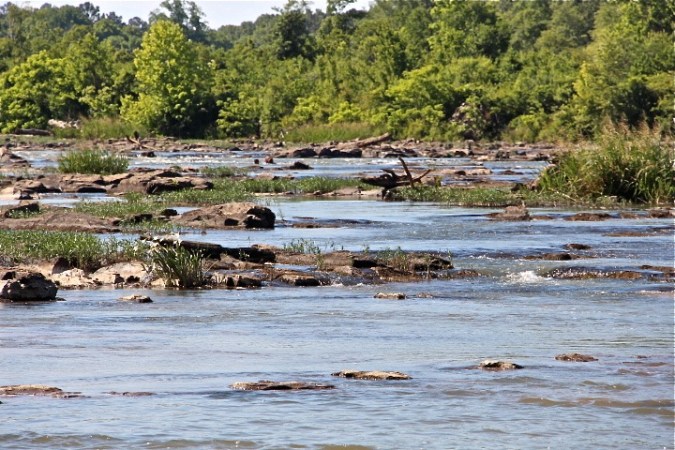
I find the place fascinating. I plan to go there soon with my camera and laptop. I’ll find a shady spot with a command of the shoals and reflect on all that’s transpired here. I’ll imagine Native Americans gazing at the rare shoals lilies of spring. I’ll watch barges poled and dragged upstream with cargoes destined for merchants in the Piedmont. I’ll see whitewater rushing through the distant mill’s millrace delivering the most natural power imaginable. I’ll watch kids playing as their parents prepare a tremendous picnic. I’ll see an artist painting his beautiful landscapes. Best of all, I’ll take solace in rediscovering a place from childhood, one I thought lay beneath lake waters like so many other long-lost treasures do.
The shoals, by the way, take their name from relatives on my Mom’s side of the family. That’s where my daughter, Becky, gets hers middle name, “Rebecca Anthony Korom.”
And now I discover that people actually pursue rock climbing there on a small group of challenging boulders, several of which have “climbable problems.”
I can’t wait to go there. I’ll spend an afternoon at a place where my Mom spent some of her more memorable childhood days, a jewel of a place that still sparkles.
Heroes of the Soil
My lunches have been simple but delicious all summer. I’ve pretty much lived off tomato sandwiches. I grow my own tomatoes in the back yard. Here in the city we don’t have that much land for planting a garden, so I satisfy my urge to farm in a simple manner: bush tomatoes in one half of an old whiskey barrel. I’m always thinking of other things I’d like to grow. The desire to grow things is one of those instincts hardwired into us. Somewhere along the human highway running from hunter to gatherer, we learned to stay in one place and grow those things that sustain us.
(The way things are going we all may resort to growing our own food soon, but that’s a story for another day.)
Growing up back home, I remember gardens aplenty. We had gardens and I remember mornings spent shelling field peas and butter beans, shucking corn, and chopping corn too. Shelling butterbeans would eventually give you a raw spot on your thumb. And shelling peas wasn’t a joy. I recall how my Dad made a pea sheller from the rolls of an old-fashioned washing machine. It worked though it smashed some peas and sent others flying all over the place.
I don’t recall, however, seeing roadside stands in Lincoln County. Maybe that’s because everyone back then had a garden. I remember for sure my Granddad Poland’s watermelons. I remember how his back porch would be stacked end to end with striped, dark green, elongated melons known, I believe, as a Congo watermelon.
That was then; this is now. Progress keeps changing things. As we become more and more urbanized, as more and more kids grow up far removed from farms, people are losing touch with what it takes to grow things. Fruit and vegetables magically appear. The many convenient ways we get food these days has created a disconnect in the minds of many as to what is actually behind a basket of tomatoes or peaches. And that, of course, is a ton of hard work, but my how the work delights the senses.
Is there anything lovelier than baskets of fresh peaches or tomatoes? How about ripe, shiny bell peppers? Or what about a basket of purple plums? I love going to grocery stores like Publix and looking at the beautiful produce, but there is a better way to enjoy the labors of farmers. This past Saturday day, my friend, the legendary Trix, and I went to a place that makes grocery store produce look like a bag of dried peas. We drove down to the Farmers Market, a collection of sheds that stands in the shadow of Williams Brice stadium.
Large fans shift the air about here, air that’s strangely sweet. The aroma of fresh vegetables and fruit commingles with the overripe air of discarded produce. It’s a fragrance strangely absent in supermarkets. In fact, supermarket produce has no smell at all.
You’ll find flowers, sod, and an assortment of Southern riches in the Farmers Market that make the summertime delicious to the eyes and taste buds.
I walked around with my camera and soon spied a beautiful stand of crooked neck squash, striped watermelons, purple plums, large pods of okra, and succulent cucumbers. And then, lo and behold, large orange sacks of Vidalia onions appeared. A short, weathered woman overlooking all these riches spied me. She walked over and said, “We’ve got Vidalias.”
She’s got to be a Georgian I figured, knowing that you can’t label onions as Vidalias unless they are the real deal. Sure enough, she’s from Brooklet, Georgia, a rural outpost just outside Statesboro.
There’s something about farmers. They seem the truest, most honest folks on the planet. Talking to her was easy as she loaded us up with a bag of Vidalias, cantaloupes, a nice watermelon, which she slapped several times. “Hear that,” she said. “That’s how it sounds when it’s ripe. Listen,” and she slapped it three more times. “Got seeds, now.”
Next we got a basket of crooked neck squash and as we talked she explained that she stays here all week selling produce grown beneath a Georgia sun. Her husband goes back to the farm and gets another truckload ready for her to sell. Pure teamwork.
I know that the current Farmers Market is destined to close by October. That old bugaboo, progress, aided by politics, is again rearing its often-ugly head. A new and better farmers market is being built over here just off I-26 and I-77 on Highway 321. This new market will feature a restaurant, an RV park, amphitheater, an agricultural inspection station, and will sprawl 2,500 feet of frontage along I-26. It’ll be bigger than seven Super Walmarts. Sort of sounds like a place to go on vacation. “C’mon kids, pile in the car, we’re going to the Disneyland for Collards and Daisies.”
When I asked this Georgia farmwoman from Brooklet what she thought about this new and improved market, worries flooded her face. She’s not sure it’s a good thing. “We got a lot of walk-through traffic here,” she said, “students and poor folks wanting fresh produce. They won’t be able to find us as easily.”
She doesn’t think the new, distant location will draw pedestrians like the quaint old market next to the stadium did. Farming is fraught with risks and anything deviating from a tried and true formula must be eyed with suspicion. The good folks of Columbia, South Carolina, are changing the ultimate destination for her and her husband’s hard work.
Of course, there’s a story behind the story here. Those of you who’ve come to see Georgia play the Gamecocks over here know that their stadium lacks anything even remotely akin to a campus atmosphere. You can circle the entire complex and you’ll spot three trees yielding shade. All three are large oaks and all three are in the Farmers Market. I can show you where some grass is, too, if you really want to know where it is.
For a long, long time the University of South Carolina and its fans have wanted to grab that property. It’ll soon be theirs. And the new Farmers Market? Well, it’ll be a ways down the road, toward Charleston. I’m sure I’ll check it out next summer, but I’m even more certain of something else. Growing my own tomatoes.
Fall and football are just around the corner, but I’m already dreaming of homegrown tomatoes sliced thick and piled on whole wheat bread slathered with mayonnaise, a dollop of sour cream (try it, you’ll like it), and a slab of sweet Vidalia onion. Add a little salt and pepper and it beats a grocery store’s wax tomatoes by a country mile. Sadly for me, it’s as close to farming as I get. There’s something about growing things that makes you a better human being, and this world needs all the good human beings it can stand, not to mention fresh vegetables.
Farming’s a tough way of life that keeps getting tougher. The next time you sit down to a squash casserole, a bowl of beautiful strawberries, or a cool refreshing salad filled with cucumbers and Vidalia onions, send up a special prayer for those true heroes of the soil, Southern farmers.

- Georgia Riches Photo by T. Poland

Beat the Heat

“Hot town, summer in the city. Back of my neck getting dirty and gritty.” Those lyrics from Lovin’ Spoonful’s “Summer In The City” resonate with us Georgians. Summer is just four days away, and though this spring has been fairly cool, well, you know it won’t last. Old Sol will bring the heat come July, and fortunately we won’t have to find ways to stay cool. We’ve got air conditioning.
Does it get hot here? Well, here’s how climatologists describe Georgia. “A humid subtropical climate with mild winters and hot moist summers is characteristic of most of Georgia.” Here’s how I describe a hot summer day in Georgia. “A searing Georgia afternoon is like sitting on a Broilmaster grill in one of those ovens that bakes black enamel paint onto cars. The air is thick and you can’t breathe. A starched white Oxford shirt sticks to your skin, which is close to melting. Your shoes feel like they’re filled with coals, and the nearest drink of water is 100 miles away.”
When the temperature climbs into the low 90s and beyond and the humidity feels like it came from a steam iron, Georgia gets hot. So hot it makes me wonder how folks got through those long summer days and evenings before air conditioning arrived. Old homes were built with large windows and high ceilings and that helped, but you know it had to be brutal.
I remember one particularly sweltering summer day as a boy. I checked the record highs for Georgia and that day occurred the summer of 1955. The mercury reached a scorching 107 in Augusta in July 1955. (Two years earlier, on July 24, 1953, the folks in Louisville reached a record high for the state, a record that still stands.)
Today we beat the heat with high-powered Carriers, Rheems, Tranes, and Lennox air conditioners. Freon, ozone problems or not, stands as one of man’s great achievements, and if you don’t think so, drive to Augusta and back with no AC. Chlorine-free Puron has replaced Freon-based R-22 and it doesn’t destroy the ozone layer. So, strike a medal for Puron’s inventor too.
But how did we cope with the heat before air conditioning? I’ll forego the old swimming hole cliché. Instead, I offer up five ways we survived.
Homemade ice cream. Kudzu. Fans. Icy Coca Colas. Freezer lockers.
How well I remember the excitement that gripped me when I saw Mom and Dad slicing peaches late on a Sunday afternoon. Mom, reaching for the vanilla extract, would make the ice cream mix and in went those peaches, nuggets of gold floating in liquid snow.
Sometimes she added cherries, sometimes strawberries, and sometimes it was just plain vanilla ice cream. Always it was fabulous.
Dad never had to tell me twice to churn the ice cream. I was on it. I’d crank away. He’d add Morton’s Rock Salt to the water making a chilling brine within which the six-quart canister turned, occasionally lodging up against an ice chunk. And what boy doesn’t remember the Morton Salt girl in the yellow dress carrying an umbrella? “When It Rains It Pours.”
I’d churn away and the churning eventually would get harder and harder. As the churn slowed, my sisters, Brenda and Deb, drew closer. When we saw ice cream oozing out the top, it was ready and off they ran. Dad would come take out the canister and give it to Mom. She’d scrape cream from the blade and soon we were feasting on cold bowls of homemade ice cream. If you didn’t get brain freeze eating homemade ice cream, then you weren’t eating it right.
Many a hot evening, often on Sundays, we’d have homemade ice cream and it didn’t matter if the mercury topped 105, we felt like it was 40 degrees!
One of the darkest days in humanity was the invention of the electric ice cream churn. Some things are meant to be done by hand and churning ice cream is one of them. But then someone got the bright idea of adding an electric motor to it and what a racket it makes, whining and grinding away.
Another way to beat the heat was with kudzu. That’s right kudzu. My Grandfather Walker would string a lattice of hemp among the columns on his front porch and plant kudzu at their base. In short order a dense, deep green screen of kudzu blocked out the sun. It felt 20 degrees cooler behind that buffer of greenery. What I remember too is the pure quality of light hitting those broad green leaves. The kudzu glowed in an emerald-translucent way that made you feel cooler just by looking at it.
Another great invention was the window fan and its cousin, the box fan. For a long time I couldn’t sleep without a window fan purring away nearby. The white noise of the fan’s blades moving air proved soothing and the cool air flowing over my skin made it easier to sleep. On one of those blistering night when you hope a thunderstorm will come crashing through but heat lightning is as good as it gets, you could get by with a window fan, something you don’t see as much these days.
It had to be that brutally hot day in July 1955 when Dad went into town and bought a box fan. He brought it home and we put trays of ice cubes in front of it. I remember how we sat so the wind could blow over the ice right at us. It was that hot. With no air conditioning, a wind hinting of ice cubes was as good as it got.
Another heat buster was an icy Coca Cola from an old timey box filled with water and hard chunks of glass-like ice, not that frothy airy ice you see today. If you reached in deep to get a Coke off the bottom, your arm went numb and your fingers tingled as if a jolt of electricity had hit them. The best Coke I ever had was on my Granddad Poland’s farm when I was a boy. Aunt Vivian went up to Price’s Store to get Cokes for all of us. We had been gathering hay beneath a fiery sun.
I was sitting against a persimmon tree on a hill overlooking the hayfield when Aunt Vivian handed me a cold Coke, rivulets of condensation dripping from it. As long as I live, I’ll remember my first draw on that Coke. The Coke was so cold, so good, that it burned all the way down my throat and my body shed about 18 degrees of heat in two swallows.
Another way to cool off was to slip and open the freezer locker and lean over into it. I’ve never been to the Arctic but I can’t imagine drier, colder air. Dense clouds of vapors rose to meet me as I opened the door. Leaning over, I’d inhale that chill air. It smelled cold and clean and from the first moment I breathed deeply, the heat left me instantly. All the frost on frozen tomatoes and vegetables looked more like frozen tundra, and for a brief interlude I had miraculously flown from the steamy latitude of 33.824 to the North Pole. All I had to do was stick my head in a freezer locker.
Eating homemade ice cream, drinking teeth-shattering Coca Colas, sitting near fans, standing behind a cool screen of kudzu, and immersing myself in the Arctic via the frosty breath of a freezer locker: that’s how I kept cool as a boy.
I was doing more than surviving the heat. I was storing great memories of a time when we found innovative ways to cool off. That’s for sure. Today’s kids walk into an air-conditioned house, ride about in an air-conditioned car, and drink Cokes from an air-conditioned box. They probably think kudzu is some new video game. I don’t even know if kids today know what homemade ice cream is. Something you get at Baskins Robbins I guess. If that’s true, what a shame. They don’t know what they’re missing do they.
Unsung Heroes
I’d had the thought before. My Aunt Imelda (Jean to many) in upstate New York sent me an email that asked a simple question. “Do you ever think of writing a column about the people who literally keep our country running. The people who never make the front-page news, never win Pulitzer prizes or any award for that matter.”
As I ran the idea through my mind, I continued reading. “I think that would be interesting and you must have come in contact with many during your life. None of us could do without these people. The home healthcare workers, teacher’s assistants, nursing aides, bus drivers, and garbage truck drivers: the list is endless. Many of these people work seven days a week and some work 70 to 80 hours a week.”
She brought up a matter that, well, matters. A lot. People cross our paths doing work deemed menial by many. As a wag once said of his job emptying and “reconditioning” portalets, “Hey, somebody has to do it.”
I thought some more about what my aunt said and people I’d not thought about in a long time reappeared in my mind. I saw old Jackson sweeping the bus station lobby in Athens. He looked more like Satchmo or some old bluesman from the Mississippi Delta. He kept the station’s restrooms clean and you could count on him for a wry opinion of the passengers. He possessed a rare kind of dignity when he went about his work.
I remembered the fellow who cut the lawn around the elementary school back in the late ’50s. I could see him in my mind, jouncing along on a lawnmower that could turn on a dime. Sitting upright and dignified, he cut the grass in a precise way. William Gartrell, I believe, was his name. I remembered people like Miss Lucille who long worked for Mr. Wengrow. She’d stand up front of the store, greet people, and help them find things. She was, in my mind, a forerunner to the Walmart greeter.
I kept reading my aunt’s email and other people long forgotten sprang to life. I remembered a man who his coworkers called “The Killer.” He earned his living at Mr. Talmadge Reed’s poultry plant where I worked during the summer of 1965. He sat at the head of the processing line cutting the heads off chickens as a conveyor belt carried the upside down, flapping birds past him. He worked with cool efficiency dispatching chickens with a smooth swipe of the knife. By day’s end he looked like a chocolate-covered cherry bitten in half … brown and blood red, all at the same time. Some times all you could see were his eyes. Somebody had to do it.
And then I remembered the man I wrote about back in the summer of 2008, “a man by the beautiful name of Moses Corley.” His job was simple. Sweep out the classrooms at a college where I taught. I wrote that “if every life is a song, then Moses’s life was a sad, sad ballad.” He’s the fellow who got fired from the best job he ever had for asking a few folks if he could borrow $10. From that point on, his life unraveled. His wife died and he lost his home, lost everything. His supervisor did not respect him nor his struggles. That was the problem.
My aunt’s email continued. “Most are uninsured,” she wrote, “with children at home and somehow they manage to have a ‘life’ of sorts. Some are still going to school trying to continue their education. Most have never been out of the country or on an airplane.”
How true I thought. How many people have I met who, while eking out a living, must also face medical bills. I’ve met many a waitress and waiter hoping to earn enough extra tips to somehow get a semester of college now and then. Traveling? Flying somewhere? Out of the question. Your lifework makes a lot of decisions for you. Automatically.
Those of you who read my columns know that my thoughts on higher education sometimes run contrary to many who laud higher education as the only way to improve your lot in life. I don’t deny higher education’s benefits, but what would we do without everyday people, our unsung heroes. In a world of egos, there are jobs most people simply do not want.
In my column, “The Work of Hands,” I wrote, “I hope we never run out of people who do true work with their hands.” Now I hope we never run out of unsung heroes. And heroes they are.
I worked as a waiter for two years while I was a student at Georgia. It taught me a lot about human nature. When you are a waiter, some people view you as a peon, someone far beneath them. Everyone should wait on tables. The experience will forever change how you treat waiters and waitresses. I once had a large, drunken party that kept sending food back no matter how many times the cooks and I tried to please them. Then they began taunting me, saying unkind things. None of this was missed by the restaurant manager. When one woman insulted me particularly well, he had had enough. Over to their table he went and the message was simple: “Get out of here. Now.”
None of the taunting got to me. Your sense of meaningfulness in work comes not so much from what you do as it comes from your belief that you’re a worthy human being. Without that conviction, any job you get can seem menial. A company president can suffer from this frame of mind as much as the wandering worker picking oranges down in Florida. Of course, the reverse is true. I read of an attorney who fled Poland in World War II only to end up in New York City working as a bellhop. Haughty, aloof, and condescending to his fellow bellhops, they stuck the nickname “The Count” on him for his snobbery. Let’s hope there aren’t many “Counts” out there.
Unsung heroes, however, are everywhere. Laborers, babysitters, folks who pick up trash, the much-maligned ditch diggers and people who make up hotel beds.
Now I’ll admit some jobs seem frivolous. In the city, you run across bathroom attendants, men who pick paper towels up from the floor and hustle tips for offering you a towel, cologne, or lotion. I’ve never felt such a job was necessary. It seems highfalutin, showy, unnecessary, but I’m sure the attendant needed the work, and I’m sure he had his own views on the hotdogs frequenting his restroom.
Unsung heroes see the world in a way others cannot. I read about a man who long worked in the fields and packing sheds. Though the work was backbreaking, he got a lot of pride from his efficiency. He never left marketable crops in the field. A lot of times he picked cotton for a living. And then along came automatic cotton picking machinery. One man who bought the machinery and fired his pickers was gleeful at his big step forward. “When the machines had done their work,” said the newly unemployed picker, “the fields remained white with cotton. What a waste.”
Sure there are jobs nobody seems to want, jobs that pay well but you need a strong stomach to do them. Garbage collector, sewer inspector, and embalmer. The money can be good but the conditions? Not for me. To each his own. That should be our mantra.
My aunt’s email concluded. “Wonderful people work hard and help keep me sane, and some days that is pretty hard to do.” She hit the nail on the head. Unsung heroes, the people who walk among us, near invisible, make life better for all, and yes, they help to keep us all sane, and they keep things running smoothly. They do an honest day’s work. It’s not asking too much to show them the respect they deserve.
Notes From The Road
Writer Tom Poland Gets His Kicks on Highway 76
And the taillights dissolve, in the coming of night …
Sensing too well when the journey is done. There is no turning back …
– Robert Plant
In a way, the journey was done for many fine two-lane highways June 29, 1956. That’s the day President Dwight Eisenhower signed the Federal-Aid Highway Act, the Interstate Act. Eisenhower, a general to the end, envisioned highways, his “broad ribbons,” laden with tanks and troops, and South Carolina got its share.
Fifty-three years, five interstates, and 757 freeway miles later, a grid of steel, cement, and asphalt makes it possible to cross South Carolina and see little of anything other than interchanges, bridges, concrete barriers, and orange safety barrels. Don’t despair. The real South Carolina is still out there. You can find the state’s true face along forgotten byways and back roads. Among those less-traveled routes rolls U.S. 76, once upon a time a cross-state thoroughfare.
Slung across the Palmetto State like a thin, low-hung belt and cosigning with 176, 378, 301, I-26, I-126, and other roads, 76 runs across the Palmetto State entire. In all, 76 runs 548 miles, east to west, from Wrightsville Beach, North Carolina, to Chattanooga, Tennessee.
And it runs through my mind, this asphalt river lost in time. For I have driven every inch of it, and I know that for those who live along its path and those who go to work on it, it flows as essential as ever. On three Sundays, I journeyed its length – past remnants of an old South Carolina and a shiny new South Carolina. My escort? The goddess Change.
Journaling a road: It’s eclectic at best. Perceptions flicker by as fast as the road’s center stripes and the recollections come fast and furious. Ride with me then down a highway and journey through time, geography, history … life itself.
Highway 76 begins unceremoniously, easing into South Carolina from Tar Heel Land. No state sign welcomes me, just a sign heralding my arrival in the Horry County community of Spring Branch. Crossing the Little Pee Dee, I’m in vintage country. A tire swings from a tree near the Spring Branch Country Store. And then Nichols, all 1.4 square miles, arrives.
This is Marion County, and echoes of the Old South reverberate here. They ring through the pastures, crops, and burnt-out hallways of charred homes. Crumbling mansions remind me that glory once lived here. I attribute this change to I-95 and tobacco’s demise.
From a weathered mansion’s column, a framed deer head stares at 76 passersby. Man’s oldest calling, hunting, thrives here. And fighting too. The town of Marion honors Francis Marion, Revolutionary War hero, and just beyond flows the Great Pee Dee, the river that missed renown in Stephen Foster’s “Old Folks at Home.” Spying the Suwannee River on a map, Foster preferred “Swanee’s” lyrical fit.
Highway 76 can be surreal. A “Broken Arrow” incident, the first, happened at Mars Bluff. A B-47, No. 876, left Savannah’s Hunter Air Force Base for North Africa. At 4:19 in the afternoon of March 11, 1958, it accidentally dropped an unarmed nuclear bomb in the woods behind Bill Gregg’s home. The bomb slammed down in gummy loam and its high-explosive trigger dug a crater 50 feet wide and 35 feet deep. No one died.
Not far away, a gunboat sleeps way down beneath the Pee Dee. The Confederate Mars Bluff Naval Shipyard built the C.S.S. Pee Dee upriver from the 76 Bridge. Because Sherman was coming, Confederates sank the Pee Dee March 15, 1865. Archaeologists plan to raise three cannons from Pee Dee silt in the summer or fall 2010.
Fields and forests fly by until I arrive in Florence, where the Drive In Restaurant claims to have the Pee Dee’s greatest fried chicken. That would please those Chic-Fil-A bovines who take matters into their own hooves and their famous cousin who lived here. In 1925 Commerce Secretary Herbert Hoover visited Fred Young’s dairy farm whose Jersey, “Sensation’s Mikado’s Millie,” set a world-champion butter-fat record.
In Timmonsville, “Cale Yarborough” says it all. NASCAR racing through my mind, I approach Cartersville and pass JB’s CB Shop, a reminder of the 1970s citizens band craze. Outside Mayesville, veins of tar run like rivers through 76, now a gravel reminder of Sumter County’s old days. From here came Mary McLeod-Bethune, civil rights leader, unofficial advisor to Franklin Roosevelt, and founder of Bethune-Cookman College in Daytona Beach, which she opened for African-American girls in 1904.
Sumter’s regal O’Donnell House commands the eye. Built circa 1840 in the Italianate style, Frank Pierce Milburn remodeled it in 1905 in the Neo-Classical style. Once a funeral home, now a social venue, it’s on the National Register of Historic Places.
So is Sumter’s restored Opera House. Built in the mid-1890s, it houses City Hall offices. Stately and evocative of Europe, I wouldn’t trade this classic opera house for 100 multiplex cinemas.
West of Sumter, the highway’s military character strengthens. Jets from Shaw Air Force Base’s 20th Fighter Wing scream over Manchester Forest. Across the Wateree River, jets streak over Highway 76 from McEntire Air Base, once known as Congaree Army Airfield.
Close by stands the last old-growth bottomland forest, Congaree Swamp National Park. World-record trees take their place among redwoods and sequoias as arboreal legends. Alas, past car dealerships and fast food restaurants and into Columbia where 76 joins I-126 near Elmwood Cemetery. Here on a bluff, the Broad River purling below, Confederate soldiers sleep.
Approaching Riverbanks Zoo, fall line rapids churn, plummet, stair step, froth, and run white. On zoo grounds lie ruins: a covered bridge and one of the South’s oldest cotton mills, which Sherman burned. Confederates torched the bridge, a futile attempt to keep Sherman out of Columbia.
I-26 soon steals Highway 76’s identity, but thankfully, 76 divorces it near a gleaming Toyota dealership. Now 76 strings beautiful beads together—small towns. It curves into Ballentine, named for E. A. Ballentine, who ran a general store in this Lexington County settlement. Built in 1929, it’s the town’s last original building. Political candidates once waxed eloquent here as wise, old men played checkers by the wood stove.
Angie Rhame opened High Noon here on Valentine’s Day 2007. In walked an elderly woman. “This does my heart good,” she told Rhame. “I was so afraid they’d tear this place down. I have so many memories here.”
A train rumbles by each day at high noon, (thus the name). In the old days as the train rolled through, an attendant snagged a mailbag from a hook and hurled a sack of incoming mail to the ground. High Noon was Farm House Antiques from 1995 until 2006. Proprietor was Carlos Gibbons, father of Leeza, South Carolina’s gift to national television.
Ballentine leads into White Rock, which melts into Chapin. From 76, you’re a stone’s throw from Beaufort Street and its eclectic shops, among them a gallery and NASCAR collectibles shop.
Just inside Newberry County, a thicket veils a vanquished farm. A poignant reminder of lives moved on, this abandonment recalls a time when small farms sustained this country. Sadly, we continue to lose our connection with the land.
Just beyond Prosperity’s old train depot sits the town square. There, Diane Folden runs Diane’s Steak House in a 1935 granite block building. A Swede laid the granite blocks quarried in Winnsboro for $3.25 a day. This was where C. Boyd Bedenbaugh operated Bedenbaugh Mules and Horses. Saturdays, farmers came to buy horses and mules. To gauge animal’s temperament, farmers walked them around the public square before buying them.
From the ’40s until the mid-’80s, the building housed South Carolina’s oldest continuously run seed cleaning business. Mrs. Jenny Bedenbaugh, whose husband’s father originally owned the building, said they separated chaff from soybeans, wheat, and oats. You could say dining takes place in a seedy place.
Imposing timbers inside once separated stables. “Many customers compliment me on the restaurant’s rustic look,” Folden said. It’s a busy place. CNN set up headquarters when she had presidential fundraisers for Fred Thompson and Mitt Romney. An Elvis impersonator gave dancing tips once during Shag Night. “We never have a dull moment here.” I’ll add that though it’s a steak house, Sunday’s fried chicken is fabulous.
Down the road apiece, an old ’50s gas station, now a dusty antiques shop, speaks volumes about I-26’s arrival. Toward Clinton, orange tiger paws adorn a shed’s roof near a Christmas tree farm in 76’s ongoing crazy quilt culture.
In Joanna, on the eastern edge of Laurens County, the Blalock mausoleum dominates the Veterans’ Memorial. Once known as Goldsville, Joanna feels deserted. Beyond its outskirts, kudzu mobs deep woods. This topiary artist gone mad drowns local forests, and somewhere beyond its green masses, I know, farmers struggled to contain red gashes in the earth.
Through Laurens and on to Hickory Tavern. Land rises into green swells as I journey past the silver shoals of the Reedy River and on through Princeton, past aluminum frying pans hanging over some small-but-precious garden plant.
U.S. 178 cosigns with 76 from Honea Path to Anderson – the Electric City, the South’s first city to transmit electricity long-distance. On November 14, 1931, Amelia Earhart flew in to the original airport in her Pitcairn PCA-2 Autogyro, promoting Beech-Nut products. Pondering her fate, I shoot beneath I-85 to La France past Pendleton’s outskirts where Samuel Augustus Maverick was born. Sam moved on to become an ornery Texas rancher, a “maverick” who signed the Texas Declaration of Independence. Thus, did “maverick” enrich our language.
Here in Foothills Country, I roll down 76 even as the land climbs. To my left sits the entrance to the Botanical Gardens of South Carolina and its 295 acres of gardens and bogs. U.S. 76 crosses Lake Hartwell and the Seneca River, where its inundated riverbed joins the Tugaloo to create the mighty Savannah, that great river of sovereign delineation.
Seneca, established 1873, shipped cotton over its rails. Then the mills came. Seneca, today, possesses a homogenized look here and there. Dollar stores, drug stores, and Mexican restaurants. On to Westminster, just outside the dark green slopes of Sumter National Forest. All that greenery makes a doublewide trailer’s bright purple roof appear radioactive. The theme of old and new commingled continues: A classic barn near Westminster faces a mobile home across Highway 76.
The Chauga River passes beneath me, a mini Chattooga. Outside local trout fishermen, few know of the Chauga Narrows, a class VI rapid. There’s where the true Earth exists. The Earth too wild to tame.
The Wild West appears in Long Creek, a strip mall that looks like a Wild West town, a place a cowboy can hitch his horse and get a shot of whiskey. No cacti live here in faux frontier land, but apple orchards fill the green folds and creases.
Now the land plunges, turns, and falls away—a roller coaster speed run. Tearing past the Chattooga Whitewater Outfitters, a business owing its existence, in part, to Deliverance and the “land of nine-fingered people.” As if by magic, the Two Redneck Chicks Café appears with twin Confederate flags fluttering, but, no, I’m not in coon-on-a-log, corn-liquor country. I am, however, approaching the land of bluegrass and dulcimer.
Straight ahead looms the river of legend, the wild, unforgiving Chattooga. This river surely is like no other. I walk onto the middle of the 76 bridge and plant my left foot in Georgia, my right in South Carolina, and watch the river run as I take stock of my journey.
Highway 76, once a mere line on a map, now lives in my mind. Between this boulder-strewn river borne of mountains and the Upper Coastal Plain near Nichols lie all my sights, impressions, and notes. I can place my finger on 76’s thread-like presence and know that here hangs a deer head, here lies a sunken gunboat, and here is great fried chicken. Opera houses, mobile homes, charred mansions, and monstrous tractors. It’s all in my head now. The blending of past and present has made my 76 explorations delightfully unpredictable. And best of all, I don’t have to thank Eisenhower for the journey.
Darkness falls on the Chattooga. The taillights of a westbound car dissolve in the coming of night. It’s time to retrace my journey, but there is no turning back. They say you can’t step into the same river twice. Nor can you step into the same road twice. I cross into Georgia to find another way back.
This feature appears in the spring 2010 issue of Sandlapper magazine.
 Tom Poland : A Southern Writer