Run The Country Like It’s Your House

A rat and a cat. Those were two things my Grandfather Walker would not allow in his house. Well there’s one thing I won’t allow in my house. A politician. That’s why I change the channel when one of those bloated, self-important knaves hits the screen. That’s why I hang up when one of their flunkies calls asking for my support and money. That takes me from calm to irate faster than a Maserati can go from zero to 177 miles per hour.

We used to have statesmen and leaders. Now about all we have are career politicians. I get a kick out of this definition of “politician” from the 2008 New Oxford American Dictionary. “Noun, a person who acts in a manipulative and devious way typically to gain advancement within an organization.”

Manipulative and devious. You can’t say it any better can you. Now and then, politicians actually respond to their constituent’s needs and momentarily become leaders, but the politically correct, those oh-so-perfect people walking among us aren’t necessarily thrilled to see government actually working. Case in point: Arizona.

The politicians in Arizona are catching a lot of flack for the tough immigration law they passed recently. They had to do something. Illegal immigrants destroy their property, shoot their dogs, and recently killed a rancher and shot a deputy sheriff. The newsboys are having a field day with that law decrying having your papers checked as a Gestapo-like tactic. Funny thing about papers. I get checked at traffic stops and have to show my license, registration, and proof of insurance. Doesn’t bother me a bit. I’ve got nothing to hide.

What the media won’t tell you is that Mexico passed an even more stringent law in 2000 to protect its borders. Under the Mexican law, illegal immigration is a felony, punishable by up to two years in prison. Immigrants who are deported and attempt to re-enter can be imprisoned for 10 years. Visa violators can be sentenced to six-year terms. Mexicans who help illegal immigrants are considered criminals.

Arizona has a huge problem and it’s attempting to correct it, but critics say they’re “un-American.” You can be sure a lot of these elitist critics don’t live along the Arizona-Mexican border. It’s easy to be holier-than-thou when you don’t have a dog in the fight.

Here’s what I have to say to the critics and politicians making such hoopla over Arizona’s law. “Get over it. God gave you some common sense. Use it. Now shut up and run our country like it’s your house.” Here’s what I mean.

When you leave home for a night, a trip, or even a quick errand, do you leave your door unlocked? I don’t. I secure my borders, arm the alarm system, and if a trespasser thinks he can sneak in and take my flatscreen because he needs to buy street drugs, he’s in for a free stay at the Crossbars Hotel.

Or how about this. You come home from a grueling day at work only to find a fellow with a shaggy head of hair and a nasty 1970 “Give Peace A Chance” T-shirt hooking a hose and a long extension cord to your garage’s outlet and faucet. “Oh,” says this neighbor down the block who hasn’t worked in a year but always has money for cigarettes, “I didn’t think you’d mind if I hook up to some water and power. Mine’s been cut off.”

The next sound you hear is a cord and hose being ripped loose.

Run your country like you run your house.

How about this? It’s a Saturday morning, a beautiful day awaits you after a week of nothing but headaches and work issues. There’s a knock at your door.

“Hi, I’m Betty and I represent the homeowner association’s “No Empty Stomachs Committee.” You have a neighbor with no food to eat. We passed a regulation to the covenant that says people with a garage now have to provide one bag of groceries a week to the unfortunate fellow down the street.

“Are you talking about that shaggy-headed fellow down the street?”

With glee, “Why, yes, that’s him!”

“Lady, you got two seconds to get the hell out of here.”

Run your country like your house.

Check out this scenario. You need some help with your landscaping and a friend recommends a fellow who sounds a bit like Fidel Castro. He even looks like Fidel but you’re a nice guy, and you do need some help. You invite the fellow inside and offer him some tea. He sips the ice-cold tea complete with a sprig of mint and drops a bomb on you in Spanglish.

“Eef you want me to wurk, you speak el español. Yo no hablo English.”

“Excuse me, who’s paying whom here. Don’t let the door hit you in el trasero on the way out!”

Run your country like you run your house.

So here you are watching the Discovery Channel present yet another documentary on what will happen when an asteroid five miles wild slams into the Kalahari Desert. Some fellow with a British accent who sounds like Sir David Attenborough is predicting the end of civilization. “And as a colossal cloud of cosmic dust obscures the sun for years, all life on Earth will perish beneath a mile-thick ice cap and the ecosystem will utterly collapse so that not even a solitary Atlantic puffin survives, not even a microorganism like the lowly but elegant amoeba.”

You find it hard to sleep; holy cow, a rock five miles wide! The coming apocalypse flies through your mind all night. At dawn a sound like a jackhammer awakens you. That pesky woodpecker is back at work on your chimney, and for some reason he prefers Saturday mornings just after sunrise. But no, you can’t just eradicate the little fellow because the little lady across the street, a self-proclaimed ornithologist, has proclaimed it to be the rare “tripled-toed yellowbelly flea-flicker.” She won’t even let you replace the weathered boards it pecks on. The chimney looks like the devil. All the neighbors complain. Out comes the pellet gun.

Or how about this. Let’s say your home sits in a neighborhood near a beautiful park. The problem is all the neighborhood kids take a short cut through your backyard to get to the park. Not only have they worn a path through your beautiful lawn, they also vandalize your possessions. They get a kick out of pushing your fountain over, trampling your flowers, and now they’re even tossing a rock or two at your windows. What do you do? Put up a sign that says, “Please be nice?” Of course not, you catch the little punks in the act, grab them by the neck, and drag them to their house and demand a stop to this nonsense.

Run your country like it’s your house.

Or how about this, a neighbor, in a moment of undisciplined euphoria, spends six months’ budget, $18,000, on a gold Rolex. Then he asks you if he can borrow two month’s mortgage money. Sounds like a member of Congress doesn’t he.

“No thanks, pal. Don’t spend money you don’t have.”

Well, hmmmm you’re thinking, this guy makes sense.

But wait, all is not well. Out by my driveway I see folks gathering with signs saying I’m unfair. They say I’m selfish. They say I should leave my doors unlocked so the homeless can find shelter in a storm. They want me to contribute to a collection so the guy down the street can have water and power and give him groceries too. What a deal. He gets everything and still doesn’t have to work.

Another sign says “Learn Spanish. It’s fun.” And the woodpecker? I have to watch my house fall apart so it can raise a brood of fuzzy-head chicks. And one more thing, they tell me, is coming. The homeowners association plans to build a sidewalk through my backyard so the kids will have a nicer path to the park. “You’ll find it advantageous not to have to cut as much grass,” reads the memo they sent.

Well you know what. No deal on any of the above. I don’t care what these people think. You know why? Because they don’t value hard work and sacrifice. Because they pervert altruism to legitimize being sorry and no-count. Worst of all, they don’t even live in my neighborhood. They’re professional protesters with no dog in the fight, but they’re such good people aren’t they. Baloney.

If I let them have their way, I won’t have a home I can be proud of. If I give in to them, they’ll drag me down with some foolish pie-in-the-sky idealism not grounded in common sense.

My grandfather felt his house was all the better for not having rats and cats in it. Our country would be all the better if we vote out all the career politicians and replace them with leaders … if there are any left who will run our country like you and I run our household.

A Simple Rule To Live By

An email came my way May 8 from one of you, the readers. It began “As I was reading your last column a thought occurred to me about families. There is a recurring theme in your columns. It is closeness with family. You speak with such fondness of your mother, your sisters, even your brother-in-law.”

“Even your brother-in-law.” That comment made me smile. The writer isn’t aware that Joe and I were roommates at Georgia and that was how he met my sister, Brenda. A brother in my life was not a possibility until Joe came along. The emailer went on to write, “The thought of families not being close is so foreign to me, but I see it more and more often.”

How right she is. More and more often, distance separates families, geographically and worse, emotionally.

The world I grew up in was close and filled with family togetherness. I grew up with family nearby, and not just some family members, but both families entire, my mom’s and my dad’s. Practically all my kin lived in the same county, a small county that nonetheless seemed boundless through the eyes of a child. That childhood land, a stretch of dissimilar terrain swept across what seemed an immense country. In the north end, boulders and outcroppings shot up from a landscape that plunged to creek beds; in the southern end, shimmering ponds dotted gently rolling pastures. It was like two different lands and far apart. I’m talking about the distance from one set of grandparents to the other.

Funny thing about a child’s eyes, distances seem enormous, when in truth they’re a hop, skip, and a jump. As a boy that trip seemed like a journey to Memphis. I’ve never measured the trip but I would gauge that it’s about 28 or so miles from Danburg to Double Branches.

How I wish all my family lived within 28 miles today. What a difference that would make. No more having to plan trips; just hop in the car and visit. Lonely? Well surprise a daughter, my mom and sisters, but no, it’s a long drive and time is short.

The sad truth is the world I grew up in does not exist anymore. Families no longer live close by one another as a rule and on top of that life demands much more of people’s free time than ever. And so, my children’s lives, and perhaps yours too, are all the poorer. No regular Sunday dinners anymore, difficulties in celebrating birthdays, no dinners together just for the heck of it. To do that requires two tanks of gas and a cross-country drive. A mere 28-mile drive goes into my family round trips 15 times. It adds up to a day, eight hours of driving along an asphalt wasteland.

My daughters and I are in constant contact via email and cell phones, but it’s no substitute for living near each other. Aware of a past they never knew, I am forever holding up a measuring stick: comparing my days as a boy to my daughters’ situations. What a simpler time that was when we all lived nearby. It was a time when grandmothers measured your growth as regularly as sunrise. Stand against the door jam, and let a Phoenix Oil pencil scratch out your height. Things changed didn’t they. Now the pencil marks a path across a map. If you have grown children living within 15 minutes of you today, how fortunate you are.

There’s the mileage kind of family distance that can be overcome with effort and there’s that distance called “apathy” that turns families into something more akin to strangers. I know people who seldom visit their close relatives. In fact, they plan things so they can avoid family. In fact, they brag about how long it’s been since they last saw a brother or parent or child, and one fellow once told me, “I hope it’s that much longer until I have to see them.” Hard to believe, for me anyway.

There’s no apathy among my family members but there are miles aplenty. One daughter lives in Lawrenceville, 210 miles from Columbia, a drive of 3.5 hours, and the other lives about 208 miles away near Raleigh, a drive that’s close to four hours, due to a long stretch of backroads highway. And so I live smack dab in the middle of a desert you could call “No Daughterville.”

I grew up old school. You go spend time with your family. And so I have lived my life with a rule I never discuss but I will now. Never live more than two hours from your family roots. From my court to my mom’s driveway is 102 miles, a 100-minute drive. That childhood trip of 28 miles? Well, it seems more like a fantasy these days. Yes, how I wish all my entire family lived within 28 miles today.

I had a chance to live in Charleston once but passed up the job offer, and a firm in Chicago wanted to fly me up for an interview a while back. I declined. Move more than two hours from your family roots and in a sense lose your family.

I realize, of course, that our money-hungry, ambition-driven society scoffs at my little rule. “You have to go where opportunity is.” No, not really. Take a map and an old-fashioned compass. Place the point on your town and draw a circle equivalent to 120 miles out. Unless you live in a desert, you’re sure to find opportunity within a two-hour drive.

So, what does it mean when your family is scattered? Well, for me, it means having to pass up certain special days, and it means having to spend a lot of time traveling the American version of the autobahn, an interstate highway. Time spent driving from point A to point B holds the potential to be a vast wasteland for sure. Seems all you do is drive. You can, however, put it to good use. Being alone with your thoughts for hours and hours isn’t necessarily a bad thing. You work things out, and besides, there’s satellite radio, music, and talk radio to keep you occupied. The miles go by, time goes by, and each minute brings you closer to your destination, family.

So, what does it mean to our society with families scattered in all directions? Not much good I’m afraid. Family ties bind us into a more cohesive, cooperative society. I think of family closeness as a sort of glue. Blood is blood, and togetherness repairs many a hurt feeling and bridges many a chasm.

Members of family used to live close together for reasons of practicality; often they owned land, family land, and often they worked that land together. Then the city beckoned; folks began leaving the farm. My nuclear family still lives on family land, a rare thing today that, as the American Express ads go, is priceless. If you don’t think so, live in a good-sized city on a sliver of land where your neighbors never speak. You share a ZIP code … that’s about it.

I was young once living in a land called yesterday. Once upon a time in that land, families lived close by each other. They shared meals, good times and bad. And once upon a time, family lived, worked, and played in the same small communities. Moms stayed home with the children and raised them right. That was back in a time when no one talked much about assisted living centers. You took care of your own.

Now you get brochures from places with names like a grove of trees … “Arbor Rest” with marketing copy camouflaged as sentiment. Copy like this: “The day comes when loved ones with Alzheimer’s need a soothing, secure place like home—a place where bountiful windows nurture time and season awareness. There comes a time when innovative care makes a difference for all—the patient and the family. Call our admissions counselor.” I know of what I speak. I wrote that brochure copy.

Long-term care insurance is a hot commodity these days that reflects the fact that families scatter like a covey of quail flushing to all compass points. Moms go to work since many homes require two paychecks today. Who has time to take care of an elder? Besides, children grow up and move away to seek new opportunities. Who’ll take care of you? No worries, the assisted living centers rise to fill this vacuum. Whereas families once lived close enough to care for the old, they turn that over to places with names like trees today.

Family togetherness? Now being together means booking airline tickets for some, and most of the time making a long drive that can wear you down once you’ve done it 200 times or more. Still, the reward comes at the end of the road. Time with your loved ones.

And when you’re not with family whom can you rely on to fill all those empty days and nights?

Well let’s see … Well, I guess that leaves friends. They’re the new family in the 2000s. At least they are close by … for awhile.

Look Homeward Angel

I appreciate the education I got in Lincoln County, Georgia. I had good teachers, but being interested in Journalism, I especially remember four teachers: Helen Turner, Lib Estes who taught me as a substitute teacher, Alice Albea, and June Kelly. I look homeward a lot these days, and I find myself recalling what these teachers taught me.

I was hopeless at first. I knew nothing. Helen Turner taught me the difference between a verb and a noun. That’s how lost I was. She introduced me to diagramming sentences and that opened my eyes to the fact that language has architecture. Her reading labs taught me to read quickly but thoroughly with comprehension.

Alice Albea once worked as correspondent for the Augusta Herald and had real-world journalism experience but her true love was literature. Her classes late in the day in a stuffy classroom nonetheless held my attention. She introduced me to Southern writers and that was the beginning of my awareness that the South is the breadbasket of great writers in this country.


To this day, I can see the diminutive June Kelly behind her podium, peeking over it through her classic “B 52” glasses and a hairstyle reminiscent of Jane Jetson. She put great emphasis on descriptive writing, and it was from her that I first saw the value of helping readers picture what they’re reading.

Lib Estes taught me that the secret to effective writing was hard work and discipline, something beginning writers find hard to accept. They place too much faith in the false god, Inspiration. Later, when I taught alongside Mrs. Estes at Lincoln County High School, I remember how her classes responded to her earnest, knowing ways.

Learning from these teachers added to my life in immeasurable ways … I just didn’t know it at the time.

Now and then someone will talk about the teachers they had and say something like, “Yeah, well I remember my teachers but they didn’t teach me anything.” You’ll never hear me say that. My English teachers didn’t know it and neither did I back then, but in a way they were travel agents. They booked a life-long journey for me. I missed a few connections along the way and there were some unavoidable delays, but the train’s running strong now and language is the locomotive.

It wasn’t always easy though. I had to get over fool’s hill as my dad used to say of some kid who was acting up. With me, Mrs. Albea had her work cut out. More than once, she had to put me in my place for making wisecracks. Her gracious comments in my senior annual betray the fact that I didn’t earn an A in conduct.

Even though I may have appeared to lose patience with you at times, I did it through love and interest—hoping that I could get through to you somehow. She enhanced my learning in spite of a big obstacle. Me. And, yes, she did get through to me.

In November 2003, in need of a getaway, I drove to Thomas Wolfe’s hometown, Asheville, North Carolina. Had it not been for my English teachers, I never would have made the journey. In a way, they went with me. I could hear Mrs. Albea’s voice talking about how Wolfe’s father ran a gravestone business, the occupation that brought that inspirational sculpture across Wolfe’s path. I could hear Mrs. Albea discussing Wolfe’s Southern roots, a literary life forged early on in Asheville.

Mrs. Turner would have discussed Wolfe’s need for structure because long rambling sentences were a weakness of his, while Mrs. Kelly would have praised his description. Wolfe could describe a headstone and make you feel the cold slab.

Mrs. Estes would have pointed out his work ethic. Thomas Wolf stood 6 feet 6 inches tall so he wrote for long periods standing, writing in a yellow pad atop his refrigerator. He threw the completed pages into a box, one by one. Mrs. Estes would have pointed out as well his need for a good editor. Like F. Scott Fitzgerald and Ernest Hemingway, Wolfe flourished under the precise eye of editor Maxwell Perkins and forged a prose style that mesmerized generations of writers.

I made a short walk from downtown Asheville late that afternoon, a misty cool day, a good day for reflection. I was thinking a lot about the folks back home. It was a typical November afternoon in the mountains, leaves in color, fading, and subdued even more by an ashen sky and drifting mists. I made my way to 53 Birch Street where the Riverside Cemetery slopes steeply to the French Broad River. Fallen leaves, moistened by the mists, made no sound underfoot. There his tombstone stood:

Tom Son of W.O. and Julia E. Wolfe A Beloved American Author

Oct. 3, 1900 — Sept. 15, 1938

The Last Voyage The Longest The Best

—Look Homeward Angel

Death Bent To Touch His Chosen Son With Mercy Love And Pity And Put The Seal Of Honor On Him When He Died

—The Web And The Rock

Thomas Wolfe lies at the hilltop not far from O. Henry. Two writers, their literary journey long over, but along the way, each, I’m sure, recalled with gratitude the English teachers who crossed their paths booking them for their respective journeys into not just the world of words but history itself.

Drift Fences, Nighthawks, & Loneliness

If you want to know what animals roam your land after sunset, you’ll need a drift fence, a sampling technique biologists favor. A drift fence is a fence of canvas or aluminum flashing, 18 inches or so high and as long as you like. Along the fence’s length, every fifteen feet, you need to sink five-gallon buckets flush with the ground. When animals drift through the forest pursuing their animal quests, the fence herds them along its edge. As they make their way along the fence, t

Your Life Story

What if you knew you had six months to live? It’s a question I pose to students in a course I teach, “Memoir, Your Life Story.” What might you write about your time in this world? Think about that.

My course is offered in a community college’s evening program. Students range in age from their 30s on into their early 70s. Quite often, many older students have spent a lifetime at some job they couldn’t stand. They’re hungry to learn something new. Restless to leave some mark on the world, they seek a creative outlet. The end of the road is coming and they are on fire to make sense of their life. Writing seems to be the path to take.

And then there’s the other end of the road. I teach students at the University of South Carolina’s School of Mass Communications and Information, (an unnecessary mouthful of words. “Journalism” works so much better.)

One semester, it so happened that I was teaching my memoirs class in the evening to adults and basic media writing to college kids in the afternoon. I told the college kids that teaching students older than me was an eye-opening experience. A young man raised his hand.

“Sir,” he said, “what’s the difference between teaching us and old people?”

“You really want to know,” I said, “I’ll tell you. Older folks would kill to be sitting where you are. Many never got to go to college. All their life they’ve had jobs they didn’t like and they are dying to learn. You kids, however, come to class late. You cut class and fidget when there’s about 10 minutes to go, sending me the signal that you are ready to go. You fall asleep in class. Your class is just one hour and 15 minutes but the evening classes I teach run three hours and the students don’t want to leave when class is over. Often the night watchman runs us out. That’s the difference.”

Not one kid said a word … the classroom was quiet.

Over the years, I’ve adopted an enlightened philosophy regarding college. No one should be able to attend college until they are at least 28 years old, maybe 30 even. Going straight to college from high school you know nothing, you’ve done nothing. You’ve yet to look down the rifle barrel known as life.

Work at a job you hate. That alone will motivate you to get a true education. Go to another country. Enlist in military service. Get some perspective on what the world is really like. Experience life. Discover your true calling. Earn a degree you’ll actually use. Live a full life and maybe you’ll write a wonderful memoir someday. Maybe.

A memoir, I should point out, is a slice of life. If you view a person’s life as a pie, the whole pie would be the biography. A memoir is one slice of the pie. A specific period revealed in all its intimacy. I enjoy a meaningful, well-written memoir as much as any book of fiction. For one thing, it’s real. I use James Salter’s Burning The Days as a model in my classes. Consider, for instance, this passage from Burning The Days on the death of his daughter.

“One night in May I had a dream of intense power—my daughter had become ill. In the dream she died. I was numb with sorrow. I went into the room where she lay, her beautiful face now closed, her long hair. Suddenly I was felled by it, brought to my knees. Tears poured down my cheeks. She was dead.

“The next morning there was a boil, like a stigma, in her left nostril. By nightfall she was desperately sick. The doctor pronounced it serious, an infection. There was a vein that ran here, by the nose, he said … I was sure she was going to die.

“At one time in my journals, beneath the date I had written, Every year seems the most terrible, but that was self-pity. The most terrible thing is the death of a child, for whom you would do so much, for whom you can do nothing. I had heard of the death of children and seen them lying helpless, but it was an arrow that would never be aimed your way.

“Nina, my daughter lived, but twelve years afterwards her older sister, Allan, died tragically. I have never been able to write the story. I reach a certain point and cannot go on. The death of kings can be recited, but not of one’s child. It was an electrical accident. It happened in the shower. I found her lying naked on the floor, the water running.”

Salter went on to say the truth, that in time the least painful thing was to forget this daughter who had died, not the kind of thing most people would confess to.

A memoir, you see, is unvarnished truth. It is real, revealing, and it may cause pain to some, though it can also cause joy after many years of anguish.

One day my phone rang. A man wanted to hire me to write an account of his life. He was ill. He was on oxygen. He had turned his back on his family many years earlier. Another woman entered the picture and he and his family parted ways. Estranged, they had not had any contact for many years. It’s a story more common than you may think.

This man, repentant, wanted to write a book, the story of his life. He had a sad story to tell. I met with him, recorded his thoughts, and began writing. We touched based daily. Several chapters took form, the work went well, and then he vanished. He wouldn’t return my calls. A month went by and then another month passed. I quit calling but one day for some reason unknown to me, I dialed his number knowing no one would answer. A woman picked up the phone. “Who are you?” she demanded.

“I was helping your dad write a book, his memoir,” I said. An awkward pause set in and then the woman began to cry. Her father had died and she had read the chapters we’d written. “Thank you so much,” she said. “We love what he wrote. It means so much to us.”

Though he never finished his book, he accomplished his goal. He didn’t live to hear the words he so badly wanted to hear but his words found their mark.

So, here we are, coming full circle. A friend of mine recently wrote, “If you knew you were about to die, would you feel you had given this life all you had to give? Would you feel you had completed your life’s great purpose? Will you go to the grave with the music still inside you? We’re all put in this life for a great purpose, and yet we come with no instruction manual. We have to find our great purpose on our own.”

What is your purpose? If you wrote your life story, what would your words be and would they find a mark?

James Dickey—231 Bullets

Sometimes Your Writing Comes Back To Haunt You

Before I read Deliverance, before I saw the movie, I heard James Dickey read from his novel one evening at the University of South Carolina’s Longstreet Theater, a fitting place. Augustus Baldwin Longstreet, a Georgia boy like me, gave his name to the theatre. What better place for Dickey, A Georgian, to read his story about Georgians, fictional though they be.

The evening came about as an accident. A friend with a literary bent was giving me a lift to the bus station, later an art deco bank and later, nothing. I was to catch an all-night local to Charleston, West Virginia.

“Dickey’s reading from Deliverance at the Longstreet Theater,” he said. “Want to go?” It was 1974, two years after the movie came out. I had time to kill.

“We went.”

We walked into the dark theater—standing room only—where the north Georgian’s voice floated over the vast hall. Dickey was deep into his story, where the Atlantans discover Drew’s body downstream. Bobby and Ed are about to sink Drew with stones, knowing the rising impoundment will forever cover him and the truth as well.

The audience sat still as stones beneath the Chattooga.

We were moving toward the white, light water and were very close to it when I saw Drew’s body backed up between the rocks and looking straight at us … I looked at Drew’s hand floating palm-up with the guitar calluses puckered white and his college class ring on it, and I wondered if his wife might not like to have the ring. But no; I couldn’t even do that; it would mean having to explain. I touched the callus on the middle finger of his left hand, and my eyes blinded with tears. I lay with him in my arms for a moment weeping river-water, going with him. I could have cried as long as the river ran, but there was no time. ‘You were the best of us, Drew,’ I said loud enough for Bobby to hear; I wanted him to hear. ‘The only decent one; the only sane one.’

Women dabbed tissues to their eyes.

That night, kept awake by a busload of singing Marines, somewhere near Hillsville, Virginia, a river ran through my head and I thought about what I had witnessed. It was an evening I would never forget.

In the minds of many, Deliverance cemented Dickey’s reputation as a popular novelist—not the poet he truly was. To me, a naïve twenty-five year old, he was a writer, pure and simple. And that was enough. Being a Georgian like him and harboring writing dreams myself, I knew I had to meet him someday. But would I?

Seeing Dickey at the Longstreet Theater was a turning point in my life, only I didn’t grasp it at the time. (I grasped little back then.) Nor did I know I would abandon a much-desired writer’s position one day, a defiant act that would, in fact, lead me to the poet.

The chain of events began one brilliant October afternoon in 1973 as I approached the end of my master’s studies at the University of Georgia. My department chairman, Dr. Juanita Skelton, a brusque, intimidating woman—professors scattered like quail upon hearing her high heels clop down the hallway—summoned me. “I’m going to give you 10 hours’ credit for teaching six months at a woman’s college in Columbia, South Carolina. You will do this.”

“Yes ma’am.”

I began teaching at Columbia College in January 1974. Not much older than my students, six months turned into four eventful years. Teaching at a woman’s college carries beautiful benefits but a career for me it wasn’t. I had an itch to write.

In 1978, I applied for a position as a scriptwriter for natural history films, a position I wanted in the worst way. To get the job, I had to survive an interview with a tough Georgian. I was nervous, dying inside.

John Culler, bearded, tall, and lanky, with a gunslinger’s bearing, could well have been Josey Wales in a previous life. It would not have surprised me had he turned to me and said, “Dyin ain’t much of a livin’, boy?”

Despite working for bureaucrats with the vision of a mole, he turned a cheap flyer into South Carolina Wildlife, the country’s best conservation magazine of its day. He and Billy DuRant, the man I’d work with, interviewed me over lunch in washed out West Columbia at a diner with a bewitching name—the Sunset Grill.

When you are young, job interviews feel like a walk to the gallows. The food was supposed to be very good—that’s why we went there—but I don’t remember anything about the interview except the very last question, which I thought was a trap, set by my days at the woman’s college, and about to spring.

We were on the way back to the office. Culler driving, he and DuRant ignoring me. Contemplating my fate, I sat in the back of a Plymouth Fury Commando V8, one of the best-loved police cars of all time, one immortalized in “Hill Street Blues” and “T.J. Hooker.” Just as we crossed the Congaree River, Culler turned and shot me a Clint Eastwood-like stare. “I’ve just got one more question. Do you like to drink liquor and chase women?”

Trap or not, the truth burst free. “Yes.”

Culler turned to DuRant and barked, “Hire him.”

During six years in the film production unit, I wrote a few features for the magazine. Then I became the magazine’s managing editor. Here, I wrote my first speech for a governor, Richard W. Riley. Here, I began to make contacts with the community of people needing the services of a writer. Altogether, I worked at South Carolina Wildlife nine years, developing the skills of a freelancer on the sly. I learned a lot about writing and even more about people, and I learned to dislike authority. And when I could learn no more, I left.

One steamy afternoon, thunderclouds gathering in more ways than one, a book contract in hand, I tallied my freelance earnings on a yellow legal pad. August 19, 1987, at 3:30 in the afternoon, I quit my job on the spot. Giving no notice, I walked out to pursue freelance writing, a world of odd assignments, books, and kooks—disappointment and exhilaration—where James Dickey and I would meet two years down the road.

Dickey’s shadow loomed over Columbia. Over the years, I saw him from afar in restaurants, on TV, and read about him in Bill Starr’s book section of The State. His life seemed one of readings, signings, and partying. He seemed to be soaking up life, the good life, drinking, reveling in life itself. On a day yet to come, talking to me, he would casually dismiss his drinking escapades, the stuff of legend. “People say that the good feeling that alcohol gives you is false—but all you have to do is live a human life to know that, in many instances, a false good feeling is better than none at all.”

I agreed with him 100 percent.

In 1989, Robert Clark, Steve Bennett, and I co-authored South Carolina, The Natural Heritage, for the University of South Carolina Press. Bennett, from Thunderbolt, Georgia, knew Dickey’s wife, Deborah, who was also from Thunderbolt, and through this connection and $800 of USC Press money, Dickey agreed to write our foreword. And so I met the man at last, some 15 years after he spoke at the Longstreet Theatre. We sat side by side at book signings. We shared the Georgia connection. His mere presence encouraged me to write. He was my muse.

We kept in touch over the phone and from time to time, on some pretense, I’d drive across town to his place. No longer were we strangers. I remember walking the shade-dappled sidewalks of Senate Street in 1990 when a festival, Mayfest, took place there, long before moving it to a public park killed it. Lost in thought, watching the sights, someone called my name. It was Dickey.

Slowly I built up a local writing career. Small steps, but steps forward, and one step involved an ambitious stride toward Mississippi where a short-lived magazine, Reckon, Southern to the core, published features about writers. And so, on a humid Saturday, June 24, 1995, I interviewed a Dickey in decline for Reckon, soon to cease publication.

A question had long burned in me: “How did he get into writing?”

At home, sitting in his wingback, on oxygen, fortified by stacks of books and wearing two watches, he answered me, telling me how language caught his ear. It started with his dad; he worked as an attorney.

“What my father liked most about the law was the courtroom rhetoric,” Dickey told me. “He had a set of books, Classics of the Bar, which gave transcripts of all the important trials from Jesus up to Fatty Arbuckle in 1929.”

Many times, Eugene Dickey read speech transcripts by Clarence Darrow and Robert Ingersoll to his son, and across the decades one speech lived within James Dickey. He recited Ingersoll’s opening statement in defense of some Southerners accused of murder.

“The Southern boys were out on the coast in the gold mining fields, Sutter’s Mill,” said Dickey. “Ingersoll’s opening statement went like this. ‘I’m very happy to talk to the gold miners. I’m very happy, today, to be your guest in this courtroom, guest of you hardy souls who earn your precarious living by wresting the precious metal from the clutches of the miserly rock.’

“My father said, ‘Now Jimmy isn’t it wonderful that a man can express himself that way.’ I replied, ‘It sure is, daddy. That’s great; read it again.’ And that’s how I got into writing, but all ways to get into writing are strange, all ways.”

In 1995, Dickey, thin as a reed, looked nothing like Sheriff Bullard. He had fears. Dickey, who had been exposed to the Nashville Agrarians, the Fugitives, feared the South was in danger of becoming one giant Rexall. Surely its last gasp was coming. The generic culture of superstores, malls, and cable television was eating the South he had known.

“Every time a new factory locates down here, everybody whoops it up—so many more new jobs and this, that, and the other, but look what it’s doing to the culture. The juke box music comes in and the traditional, Southern, Appalachian ballads go out.”

Dickey, of Georgia mountains, grew up hearing the twangs of bluegrass music echo across the valleys and he didn’t like contemporary country music. He was a purist. He never used a word processor, just cheap Japanese typewriters. “I think it’s too much machinery between you and what you’re writing, with those electronic devices.”

I will go to my grave believing one thing about James Dickey. Had he used a computer he would have finished his sequel to Alnilam, Crux, and another novel for sure.

I wrote 231 words in Reckon about Dickey’s drinking. I wrote that his drinking “led to overindulgence and damage.” Didn’t think twice about it. It seemed “writerly,” and I was impatient to get my hands on the Winter 2006 issue. Dickey got his first.

My phone range in the quiet moments of dusk. It was Dickey. My heart leaped. He loved the piece. I knew that’s what he was about to say. No. “Why did you have to write about my drinking? It hurt me and it hurt my family.”

His words stung me. The call ended badly. I gave him a wide berth for a while. I wasn’t sure what to say to him. The months rolled by and I struggled: what to do, what to say. A year passed. Somehow I knew I had to make amends.

One Monday morning while shaving, I heard the news report. Dickey had died the night before. I felt a loss. And guilt. From that first reading at Longstreet Theater to the foreword for my book to estrangement, and now this, the end. You can’t break a circle that isn’t complete. I knew one thing. For James Lafayette Dickey, his circle was complete at last. For him, “by and by, by and by
, there’s a better home awaiting, 
in the sky Lord, in the sky.”

In time, I put it all behind me but then Henry Hart came out with his unkind 811-page biography: James Dickey, The World As A Lie. Hart, with hair like Moe of the Three Stooges, had done exhaustive research. There, on page 733, my damning words rose like demons to renew my haunting:

“Dickey acknowledged how destructive alcohol had been to himself, his family, and everyone associated with him. In July, he told a writer for Reckon magazine that, while alcohol had enhanced his confidence for years: ‘I am forever off drinking. God could not get me to drink, Him and Jesus combined. That’s over. Dickey decried his lack of judgment in the past and advised his interviewer: ‘You ought to quit, too. Don’t let it do to you what it did to me.’ ”

I was a hypocrite.

I recall an icy December night in 1989. Robert Clark and I went to Dickey’s home with twenty-seven copies of South Carolina, The Natural Heritage for Dickey to sign, Christmas gifts. Intending to drink with the man, Robert and I brought bourbon as a gift: Jack Daniels Single Barrel Whiskey I believe. I remember the bottle was pretty.

We arrived on time. 7:30 p.m. Dickey met us at the door in his pajamas. He had no need to drink further. He took the bottle and placed it high on a shelf. Then after signing the books with his ornate signature, he asked us to join him in his study. There, to my disappointment, he asked if we were from the South.

“You know I’m from Georgia, like you,” I said, “and Robert is from Charlotte.”

“Good,” he said, grabbing his guitar. “Then you know the old Southern gospels. Let’s sing.”

And with that pronouncement, he launched into “Will The Circle Be Unbroken.”

I was standing by my window, On a cold and cloudy day, When I saw the hearse come rollin’ For to take my mother away.

Robert and I stood there mute. Dickey stopped strumming.

“You boys said you were from the South, c’mon, let’s go,” and with that he took up the song, singing with all his might.

Will the circle be unbroken? By and by Lord, by and by

Robert and I involuntarily took a step backwards and looked at each other for help. Dickey stopped again, stood, and stared with anger.

“I can’t sing a lick,” I said in apology.

“Me neither,” said Robert.

Dickey moved toward the hall. “Boys, I’m a busy man. I’m expecting a call from my agent any minute.” He showed us the door.

In the space of 15 seconds Robert and I were out in the cold, a precarious stack of books in our arms, wondering, exactly, what had hit us. Wondering what happened to our night of drinking with the Deliverance poet. We pretty much knew what happened to the Jack Daniels.

That cold December night was soon forgotten. We stayed in touch, and I proposed the feature to Reckon and Dickey agreed to an interview. Toward the end of our 1995 interview, Dickey discussed his failing health. “I met the Dark Man. I’m very much aware of mortality. I’d like to think I have some more years, maybe 10, 12, or 15 at the most, but that’s in the lap of the Gods.”

The Gods were tightfisted. He had but nineteen months.

Dickey died January 19, 1997. He left a novel unfinished and he left critics aplenty, especially in Columbia, South Carolina. Some colleagues felt he was a horse’s ass. One professor told me he couldn’t stand the man but in the same breath said, “Deliverance was a helluva novel.” I tried to defend the man, but heard instead, “To those who much is given, much is expected.”

Dickey left eloquent defenders behind. Jeffrey Meyers wrote in The New Criterion: “James Dickey, handsome, blond and blue-eyed, formidably energetic, large, and larger than life, scaled the heights. College athlete, air force navigator, advertising executive, guitarist, archer, hunter, teacher, performer and poet laureate, winner of a Guggenheim fellowship and a National Book Award, he covered the Apollo launching for Life and read his poetry at President Carter’s inauguration.”

Dickey was an icon to me. I didn’t care what his critics thought but I sure cared what he thought, and I had hurt the man. He had encouraged me to write, (“You underestimate yourself”) and thanks to my freelancing, I could relate to him. His stand on writing ad copy versus poetry is memorable. “I’d sell my soul to the devil by day and earn it back at night.”

To this day, when asked how the freelancing life goes, I respond, “Every night is a Saturday and every morning is a Monday.” Were he here, Dickey would nod and say “Amen.”

Dickey was laid to rest at All Saints Waccamaw Episcopal Church cemetery on Pawley’s Island, South Carolina, on a chilly sun-paled January day, everything blue, everything dead.

One afternoon in 1997, a summer thunderstorm raging, a student and I drove to his home so she could say she had seen Dickey’s house. There was no home. Its location had been sold. Nothing remained but rubble and bulldozer tracks. We trekked through the rain and returned with three bricks. She kept one. The other two sit in my office. Alongside them is a smooth stone I picked up from shallow Chattooga waters, monuments you could say. That was twelve years ago.

A new home sits at 4620 Lelia’s Court today, overlooking Lake Katherine. No marker, nothing, tells the passersby that the poet and author of Deliverance created literature and art here. What a shame.

When it comes to James Dickey, there are regrets aplenty to go around—on all sides. Among them, a share belongs to me. I earned it when I yielded to the temptation to disparage a man just because it seemed stylish. The thing to do, as so many others had.
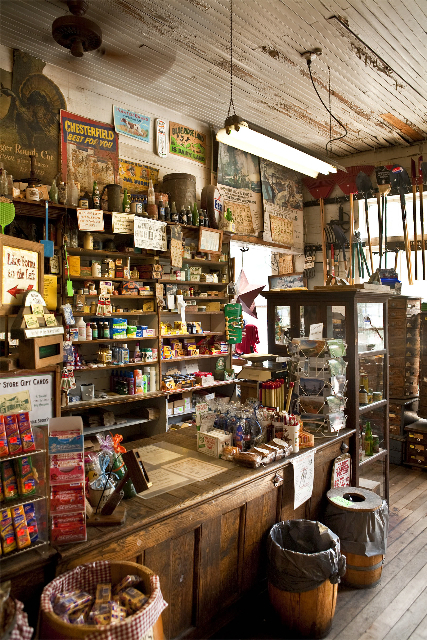
The Gathering Place—The Country Store

Across The Savannah

You never see a true country store anymore. Changing times and interstate highways put them on the endangered species list and today weeds, kudzu, and pines advance through and over their empty shells. For decades, country stores stood as compact yet quaint centers of commerce, ready to dispense most anything, and just as importantly, provide gathering places to socialize. In rural areas, they stood as beacons to anyone who needed a plug of tobacco, mule collar, most anything, especially a chance to talk. A trip to the “general store” never disappointed.

country store-robertclark

Photo by Robert Clark

Most, if not all, are out of business, but for many of us good memories of country stores linger. What child of the South doesn’t remember country stores with happiness. I feel sorry for today’s youngsters who miss out on a trip to a general store. I just can’t see a group of 10-year-olds gathering in 2062, silver haired, reminiscing … “I tell you, there was nothing like a trip to Wal-Mart. Remember the plastic brooms and kitty litter? And those giant cartons of toilet tissue? We even bought plants there and grew our own flowers. Man, those were the days.”

A true country store had character no Wal-Mart could ever muster. It always sported a classic Coca Cola sign. You can still see some of those iconic signs clinging to old stores, their green and red colors washing out, victims of weathering, the store’s name fading … just as its business did.

Drawing on childhood memories, I wrote about one of the country stores of my youth in a novel, Forbidden Island. Embellished with bits of imagination, it went like this …

“Instead of pulling in and parking, I should have been dismounting and hitching my horse for Prices Store was of the late 1800s. The parking lot was sand, nothing more, just oil-stained sand. Two rusting Mobil Flying Red Horse gas pumps stood side by side like liver-spotted Wal-Mart greeters. Inside, two front windows filtered light through panes thick with khaki-colored dust. Off to the right, an old man was slicing wedges off a huge wheel of soft cheese. Motes of dust sparkled in shafts of sunlight slanting through cracks in the wall. It was primitive like all true country stores are primitive.”

A trip to a country store was one of childhood’s joys, a time for joyful self-indulgence: sweets, treats, and adventure. My grandfather ran a country store on Highway 79. He sold minnows from an outside tank. Inside, half-gallon jars with red lids held assorted cookies as big as your hand. The countertops glittered with colorful candies. It was a child’s paradise.

He sold penny candies like Mary Janes, those chewy bite-sized peanut butter and molasses candies, Lifesavers (the summer candy that withstood heat better than chocolate) and Bazooka Joe bubblegum, staples we kids loved. And we coveted Moon Pies too. It may be a cliché how the phrase “RC Cola and a Moon Pie” became part of the Southern lexicon, but it’s based in fact. Cokes with peanuts was another great combination too. Pour the peanuts into the bottle and enjoy!

Granddad sold Beechnut Chewing Gum and coconut candy with stripes of pink, white, and chocolate flavors, can’t recall the name but it was great. A good time was always to be had there, along with pranks and mischief. My cousins and I used to cut the spear-like leaves from a nearby Yucca and spear granddad’s minnows. It wasn’t exactly like shooting fish in a barrel ’cause the slippery rascals darted about, but we were persistent. Granddad never figured out why his minnows kept disappearing. And it’s a good thing he didn’t!

For a long time, Granddad didn’t use a cash register. A wood drawer stored folding money pressed in place by a vintage Ford’s chrome greyhound hood ornament. It’s hard to imagine anyone today keeping their earnings in such a simple place, but it was commonplace back then.

A place of commerce, yes, but it was more. It provided a focal point for the community. Mom remembers that Saturday evenings, Bud Sow, a local Black man, would come and tell animal stories to the children, generally reversing the animals’ names. A grasshopper became a hoppergrass. He was a local Uncle Remus of sorts and the children loved him and his tales.

Men would come and shoot bottle caps at cracks in the floor to see who would end up buying “dopes,” an old reference to Coca Cola, which once contained cocaine. (In its early days, Coca Cola contained nine milligrams of cocaine per glass.)

Mom recalls as well that her dad’s old store had a “cat hole” in the floor where a cat came and went. The cat hole proved handy to mom’s sister, Evelyn, for tossing goodies for retrieval later. On one occasion, Evelyn (We call her “Aunt Sister) had some fun with her younger brother, Carroll, who was bugging her for some Lifesavers. Superlax, a laxative, looked much like Lifesavers, and she gave him all he wanted all right. Uncle Carroll spent the rest of the day at the outhouse.

Mom also remembers that Thursday nights, mullet came in on ice from the coast for a fish fry, and the children always looked forward to that. A country store provided a rhythm of life as well.

I possess clear memories of my granddad’s store and Price’s Store. I see the crates of drinks stacked high. Simple bulbs hang from the ceiling. And I see old men sitting on the benches that flanked the front door to Prices Store. A country store was an educational institution. Men shared what they knew over smokes and Cokes for no country store was without cold Cokes.

The coolers at Prices and Granddad’s stores were nothing like today’s automated stand-up dispensers. Their coolers were filled with water and ice and the Cokes bobbing around would just about send you into hypothermia. You’d fish around getting a Coke from the bottom, pulling it out with a hand numb from Arctic-like water. First thing you did was check the bottom to see where the magic beverage was bottled.

The coldest Coca Cola I ever drank came from Prices Store. It was a blazing hot summer day and I was helping gather hay on my grandfather’s farm. Aunt Vivian went to Prices Store and returned with a cooler of Coca Colas for all the workers. Sitting beneath a persimmon tree on a hill, breeze in my face, I downed it in seconds, cold and crisp. So cold it burned. That Coke was the one I’ll never forget. Sheer delight.

Of course, country stores sold other soft drinks, Orange Crush was one of my favorites. Rush! Rush! For Orange Crush was an ad I recall. And then there were the Nehi beverages. Some of you silver-haired types will recall Nehi Grape and Nehi Orange drinks. (Nehi became Royal Crown Cola in 1955.)

You could buy Nutty Buddy ice cream, Squirrel Nuts, BB Bats, Candy Cigarettes, and Sugar Daddys and Sugar Babies at a country store. A Sugar Daddy had to be a dentist’s best friend because it would just about pull your teeth out. And some of you’ll recall Dreamsicles, too, an orange sherbet ice cream on a stick.

All that lives in a place called Memory now. All that lies in gathering dust. For me, it amounts to a line drawn in the sand: life beyond country stores would never be as real. Indeed, when those of us who remember country stores go to that great general store in the sky, the little stores and the lifestyle accompanying them will be gone at last.

Semblances remain though, sort of. I tip my hat to Cracker Barrel. At least it has some of the look and feel of a country store … if you ignore the waiting line and stare at the old signs and classic Coca Cola icebox filled with ice-chilled Cokes.

Maybe I’ll find another one up in the mountains some day or in some long-forgotten outpost. If I do, I’ll take a lot of photos. Or maybe you’ll find the last country store, not quite a victim of progress. Not yet.

The next time you pass a country store, one that’s long closed, its paint peeling, weeds and trees overtaking it, roof sagging, let your imagination loose. Envision it in the prime of life. You’re bound to see classic cars, vintage pick-ups, men in coveralls and ladies in floral print dresses buying provisions and sharing news. You’ll see a bench with old men whittling and whiling away the day and old glass-bubble gas pumps with gas 16 cents a gallon.

Out back, some boys, no doubt, will be up to no good. Inside you’ll find candies, supplies, a freezing Coke, and best of all, friends in the gathering place, the country store, yet another victim to that wonderful thing called progress.

Email Tom with feedback and ideas for new columns. tompol@earthlink.net

An Economy For The Birds

Across The Savannah

Hummer In Flight

Photo by Tom Poland

I was on my way to buy sunflower seeds for my bird feeders, which the squirrels, especially, appreciate. Along the way, a vagabond perched near the interstate holding a sign, “Will work for food.” I see guys like him a lot. Usually, they come in pairs and work both sides of the intersection. I hear it’s a scam.

I drove on with no guilt about feeding birds, not humans. I suspect the drifters had birds in mind too—Old Crow and maybe dreams of Wild Turkey flitting through their scalawag heads, if they “worked for food” long enough.

At Lowes, I was checking out 20-pound sacks of sunflower seeds when a fellow in a business suit walked up. “We’re spending money on birds and a lot of folks are out of work,” I said. He laughed and said, “Times are tough all right unless you’re a bird”

That’s for sure. The U.S. Fish & Wildlife Service estimates that 53.4 million Americans drop nearly $5 billion a year to see nature in action. That ain’t chicken feed, folks.

My backyard hosts two birdbaths, three feeders, a hummingbird feeder, and a fountain. Running water sounds like a dinner bell to birds and when the fountain cascades rivulets, a feathery ensemble descends on my yard. Cardinals, finches, orioles, woodpeckers, brown thrashers, and other birds arrive in such plentitude my backyard becomes a wildlife refuge.

I work at home and filling the feeders brings entertainment and now and then a lesson about life. Besides, birds and I are old friends. We share a professional connection of sorts that goes back nearly 30 years. Watching birds provides a break from writing these days, but in the past birds meant work. As a cinematographer in the ’80s, a series of films regularly took me to Cape Romain Wildlife Refuge off the coast near Charleston.

Long days … I’d board a U.S. Department of Interior Boston Whaler at McClellanville well before dawn and spend the morning filming shorebird rookeries on small, low-slung islands. Rookery islands are flat, sandy places. Little vegetation grows there. A mere scrape in the sand suffices for a nest. The speckled eggs look just like sand. I stepped carefully.

Rookery islands are wild and pristine. They hold no trappings from civilization. They truly are for the birds. A beautiful place, sun splashed, wild, and desolate. And desolation is where the business of raising fledglings best takes place. The Department of Interior owns this territory; it’ll never become another Hilton Head. You’ll never see pot-bellied men in golf carts riding along where baby pelicans grew up. It’ll remain barren yet full of life: a ravishing contradiction.

Back in the ’80s, I took that natural splendor for granted. It was a job. Work. Now, reminiscing with the benefit of a bit more maturity, I realize I was in a place magical and majestic—bird land—a bird watcher’s paradise. Islands with names like Cape and Bulls sit off the Lowcountry just beyond where the edge of North America slips beneath the Atlantic. Farther out beyond the islands, the warm Gulf Stream courses through the sea. Life’s basic elements abound here.

The ancients believed the world consisted of air, fire, water, and earth. Perhaps they had their own feathery islands in mind. On islands such as Cape Romain’s, the sun bears down with the fury that melted Icarus’s wings even as it incubates eggs destined to fly in another life of sorts. And there, in those scrapes my feet avoided, the sand was nothing more than the remnants of ancient mountains, long washed into the Atlantic and built up into isles. There I was walking across aged peaks shooting scenes for TV and film.

It seems like only yesterday that I trained my Arriflex on pelicans crashing into the sea in search of menhaden. There in that sun-bleached land, I loaded film magazines and shot footage of baby pelicans, brownish-purple blobs with bobbing heads and oversized beaks. At day’s end, the sun sinking over the continent, the U.S. Department of Interior guide would take me back to the mainland. Hot, hungry, and tired, I made the long drive back to the office and sent film off for processing.

Looking back, avian moments stand out from my bird-filming years. Seeing my first Bald Eagle wheeling overhead, its regal white head flashing in the sun. Spotting the oh-so-rare Swallow-tailed Kite (the Arriflex was cased, useless when I needed it most). Filming baby wood ducks leaping on high from a tree cavity, bouncing off the forest floor like yellow tennis balls, then forming a fluffy, yellow train to follow mom to a beaver pond. Their inaugural swim waited.

That was then. Backyard bird life is tamer by far. One moment, though, stands out. A tender moment. One morning a bird crashed into my sliding glass door with a sickening thud. Opening the door to my deck, I saw a female house finch on her back, feathers ruffled on her right wing. Spasms racked her little finch body. I was sure she was dying.

I reached down to pick her up, and the sight of me was enough to get her to fly. Somehow she flew to a nearby pine, latched onto a small limb, and hung upside down by one foot. Her redheaded mate flew to her side at once, chirping in a way that sounded like pleading. “C’mon, don’t die. You can make it. Please don’t leave me.”

The male kept nudging her with his beak and pacing the limb she clung to. I expected her to drop in a freefall of death. After what seemed an eternity, she struggled and managed to stand upright on the limb, wobbly at best. Her mate nudged her more, chirped louder, and after about 10 minutes, the pair flew away. Later that afternoon I spotted her, wing feathers still askew, at a feeder, with her mate right beside her. All seemed right in her world again. Mine too.

That old expression, “for the birds,” generally carries a touch of sarcasm implying something is no good. “This economy is for the birds.” Well, there’s nothing worthless about feeding and watching birds even in tough times. The best thing about my backyard birds is that it’s not work. I don’t have to cart heavy equipment around, keep batteries charged, avoid camera tilt, or unload film magazines. I don’t make any money doing it; in fact, it’s just the opposite, but it’s fun. And sometimes quite revealing.

Email Tom with feedback and ideas for new columns. tompol@earthlink.net

The Giving Tree

Across The Savannah

The Giving Tree

Growing up, two sounds greeted me upon awakening each morning. Close by, the snarl of chainsaws being tested at Dad’s shop rose and fell like some prehistoric cicada. More distant was the drone of Mr. Henry Partridge’s sawmill. Neither the saws nor the mill could exist without the other. They had one thing in common: an appetite for trees.

What brings this memory into focus is an innocent remark a friend made the other day. I was talking about my land back home and how it has beautiful oaks and hickories, but few pines. “Why doesn’t it have pines,” she asked, going on to say pines are the South’s dominant tree.

“Not so,” I said, explaining how the faster-growing Southern Yellow pine makes a better cash crop than the dense-grained, slow-growing hardwoods. Left alone, a forest is forever changing, and a cycle of plant succession ultimately results in hardwoods. We just don’t give the hardwoods a chance now. And so, pines rule much of the South in a sort of suspension of the natural cycle, by default you could say.

“Pines, the Green Monoculture,” he said. His words dripped with contempt. Americus native John Culler, founder of South Carolina Wildlife magazine and a sportsman, disliked pine forests because they offer deer and turkeys little nourishment compared to hardwoods’ acorns, nuts, and fruits. Others liken a huge forest of pines to a green desert. And when it comes to fall color, pines are a no show though they shower us with gold dust in the spring. Yeah, what joy pine pollen is.

You see more pines than oaks for sure, except in pockets where hardwoods’ canopies deny pine seedlings the light they need to grow. What, then, helped pines ascend to their faux dominance?

Let’s turn back the clock to 1830 in Germany. An orthopedic surgeon, Bernard Heine, needed a better way to cut bone. He developed a guide around which a chain could move, cranked by hand. Just like that, bone cutting became far easier. Time moved along and a German mechanical engineer, Andreas Stihl, patented the first hand-held gas-powered chainsaw in 1929. Just like that, cutting trees got a whole lot easier. Folks in the know say Stihl is the father of the modern chainsaw.

The chainsaw gave hand-held crosscut saws and the axe the axe, so to speak. Funny thing, too, about the chainsaw and those woodsmen of long ago. It elevated the lumberjack, a disdained laborer at one time, from the bottom of the social ladder to that of respected specialist. Logging is now among our biggest and most important industries.

Are you a tree hugger? Hate to see trees cut? You can divide people over issues involving forestry, wetlands, global warming, and the destruction of habitat, but that aside where would we be without trees? As I write this, I’m sitting at an oak desk in a house sided with cypress. From wooden cabinets and desks to books, magazines, and papers, the remnants of trees surround me. I’m sitting in a glade surrounded by trees that made the ultimate sacrifice. I owe them much. We all do. We can repay our debt, however.

Plant a tree. Even better, help a child plant a tree. Create a legacy, a living lesson that teaches much about nature, the seasons, and man’s relationship with forests, a major chapter in the human saga. Trees and woods have played major roles in literature. Look no further than William Faulkner’s short story, “The Bear” for a classic story. Among its themes, Faulkner’s masterpiece explores the gradual loss of wilderness to frontier settlement—the loss of millions of trees.

There’s a beautiful children’s book, The Giving Tree, by Shel Silverstein, a short tale with a moral about the loss of one tree. A boy and an apple tree become fast friends. The tree always gives the boy what he wants: a branch to swing from, a shady place to sit, apples to snack on, and branches to build things with.

As the boy grows older, he wants more and more from the tree. The tree loves the boy so it gives him anything he wants. Lying in the tree’s shade with a girl, the boy carves her initials in a heart in its trunk. Then one fateful day, the boy decides he needs a boat. In the ultimate act of self-sacrifice, the tree lets the boy cut it down so he can build his boat. Nothing remains but a stump, and then the years roll by.

One day, the boy, an old man now, returns, and the stump says, “I have nothing left to give you.” The old man says he just needs a quiet place to sit and rest. The stump obliges.

Giving everything and getting nothing in return. That’s the life of a tree.

Many giving trees have sustained us our entire lives in many, many ways and they will continue to do so. Meanwhile, we go about our busy lives giving trees no thought. Gripping the ground with their roots, their crowns swaying with the wind, trees go about their business quietly converting sunlight, minerals, carbon dioxide, and water into new generations of trees destined to give their all in the ongoing cycle of death and renewal, satisfying the appetite of other saws and mills.

Email Tom with feedback and ideas for new columns. tompol@earthlink.net

A Blind, Unkind Law

Across The Savannah

A Blind, Unkind Law

In the summer of 2008, a manuscript crossed my desk. Sylvia, a mother in need of an editor, had written a 200-page memoir about her son’s battle with Bipolar disorder. You may know it as Manic Depression.

Sylvia’s son, Bryan, was 27 when diagnosed with Bipolar disorder. Like an earthquake, Bryan’s illness struck without warning, shattering his and his family’s life. From the start, it was sheer chaos. The first time Bryan was hospitalized, he told his mother, “This place is not really a hospital. It’s a training ground for the CIA. My room is bugged. All my conversations are monitored. These people are not doctors and nurses. They’re actors.”

Today, Bryan’s mother is an advocate for the mentally ill and she champions a burning cause: changing state laws that overprotect mentally ill adults’ rights and force their family to watch helplessly as their love one falls deeper into mental illness. Most states have a law that says, in effect, you can’t hospitalize mentally ill adults without their consent unless they present an imminent danger to themselves or others. The law’s intent is to keep people from being confined just because someone says, “they’re crazy.”

That very thing was common in the Soviet Union. During Stalin’s reign, for instance, a Moscow court found a young woman, a writer prominent in civil rights, to be unstable. Her real crime was protesting illegal trials. Tried in absentia, she was declared mentally ill and placed in an institution.

We’d never tolerate such an abuse in this country, and that’s what this thorny law tries to prevent. In Sylvia’s view, however, laws protecting genuinely mentally ill adults go too far. Suppose you have a child who is bipolar. Put yourself in her situation. Who is a better judge of your child’s behavior? You or some judge with an overloaded docket?

Sylvia raised Bryan. She knew when he was slipping into mental illness. She knew when he was not taking his medications and deceiving the doctors, judges, and others who let him roam the streets manic. Trust me, she knew when he needed to be hospitalized.

A mother’s tears have fallen on every page of Sylvia’s manuscript. The experiences she shares break the heart. Many nights Bryan would call his mother at 3 a.m. to tell her he was the president of the United States. He’d give his credit card to homeless people. He would quit taking his medications. When he did, bizarre things took place: He’d dump several hundred dollars’ worth of coins all over his church parking lot and write a $10,000 check to his minister. He told his mother God had commissioned him to write another book for the Bible.

He’d disappear for days and his family would fear the worst. Then he’d resurface in a full-blown manic state and accuse his psychiatrist of trying to poison him with prescriptions and fire him. He threw away his cell phones because he believed the Secret Service had bugged them. He grew more and more delusional, would take off on long drives across several states asking state troopers to escort him because he was the president of the United States avoiding Russian agents who wanted to kill him. He told people he was in the witness protection program. He sent a woman 48 dozen red roses—a dozen an hour—for 48 hours to the tune of $2,300.

The really bad episodes enabled his family to get him before a judge, but the judges released him, fooled by his ability to act normal. In fact, he became an expert at fooling doctors and judges, but he couldn’t fool his mother and family. Blindly enforced laws left Bryan and his family headed for catastrophe, but he’s not alone.

Perhaps you saw A Beautiful Mind, a movie based on the true story of John Nash, a Noel Laureate in Economics who had schizophrenia. The film takes up the story in Nash’s early years at Princeton as he develops an extraordinary idea that will revolutionize mathematics. The storyline deals with mental illness. Nash developed paranoid schizophrenia. He believed he possessed top-secret Soviet codes and feared Soviet agents were trying to kidnap him. This illness and its grandiose imaginings that struck Nash and Bryan is more common that you think.

I had a neighbor who was Bipolar. When he got off his medications, he’d grow delusional and paranoid. He stuck the barrel of a loaded handgun to my chest one day and other neighbors and I had him committed for observation and treatment. He had become the law’s “imminent danger to others.” I moved eventually, in part to get away from this man, who himself moved to Georgia up near Atlanta.

And Bryan? What became of him?

Early one cold February day, Bryan got in his car in his garage and started it up. He never bothered to open the garage door. His destination was far beyond anything on the other side of that door. At the age of 40, after 13 years of Hell, he slipped the surly bonds of earth, free of his terrible illness at last and was no more. Tears continue to fall on every page of Sylvia’s manuscript to this day.

Friends, you never know what’s down the road. Sylvia and Bryan’s sad story could be yours someday. For many, it will. Something like 15 to 18 percent of Americans possess a diagnosable mental disorder. No socioeconomic group is free from the sting of mental illness. Mental illness affects one in four individuals. There but for the grace of God go you and I …

When passing laws to make it illegal to force mentally ill people into treatment, lawmakers failed to make provisions for people like Bryan. He didn’t think he was sick, but he was. Very sick. If you don’t realize you’re sick, how can you make rational decisions regarding your treatment? The answer is you can’t. It’s the families of mentally ill people who are the first to recognize their loved ones are ill, but the law renders them helpless.

It makes sense to amend such laws. A judge sees you for 30 minutes but your family has known every fiber of your being for as long as you’ve lived. If you or someone you love spirals down into the deep, dark abyss of mental illness, wouldn’t you want your family to be able to intervene on your behalf? I sure would.

Email Tom with feedback and ideas for new columns. tompol@earthlink.net