Riding The Chitlin’ Circuit

A writer is only as good as his material, and now and then something profound falls into his lap. For close to two years now I’ve been working on a book for the University of South Carolina Press. Early chapters of the book concern the blues.

A major part of writing is research. It’s akin to mining for gold; you get a lot of dirt but few nuggets. In this case, however, the blues turned up a nugget of gold, black gold.

Frank Beacham, a journalist originally from Honea Path, South Carolina, wrote a penetrating chronicle called “Charlie’s Place.” The story originally appears in his book,Whitewash: A Journey through Music, Mayhem and Murder (available athttp://www.booklocker.com/books/939.html). Frank and I exchanged emails, and he granted me permission to excerpt his account of Charlie’s Place and the Chitlin’ Circuit. It’s a story that’s Old South, and it brought back my childhood in several telling ways.

Envision a dazzling marquee ablaze with these names … Cab Calloway, Ray Charles, Duke Ellington, Ella Fitzgerald, Lena Horne, B.B. King, Wilson Pickett, Otis Redding, The Supremes, The Temptations, Muddy Waters, and quite possibly the first true rock and roll star, Little Richard of “Tutti Frutti” fame, Awopbopaloobop Alopbamboom.

They came to entertain on the Chitlin’ Circuit, a string of clubs and joints throughout the South where black performers could do their thing in a safe acceptable venue. Finding a place to eat after the show and a room for the night? Well that was another matter. Entertainers destined for greatness had to find accommodations with friends.

That’s the way it was in the era of Jim Crow, that strange name representing the era of supposedly separate-but-equal facilities. That time of sitting in the back of the bus, of drinking from water cooler’s marked “Colored Only,” and not sitting at drugstore counters. Nor, in a bit of reverse discrimination, were whites supposed to mix with blacks to enjoy music, something we take for granted today.

Charlie’s Place was on the Chitlin’ Circuit in an alcove, so to speak, known as Whispering Pines over Myrtle Beach way. The pines began whispering, as Beacham wrote, the night Billie Holliday sang at Charlie’s Place. Thus did the name Whispering Pines come to be. Other black performers destined for greatness came to Charlie’s Place including Georgia’s aforementioned Little Richard.

Charlie Fitzgerald, a chic black entrepreneur from New York, ran Charlie’s Place from the late 1930s until his death in 1955. Charlie’s Place, it should be noted, had a reputation as a peaceful establishment but that didn’t head off trouble. As Beacham wrote, “Fitzgerald’s coziness with whites was out of sync with the time and place. Racial tension in South Carolina began escalating after a federal judge opened the state’s Democratic primary to black voters in 1948. It was to the chagrin of many Southern whites that blacks began to assume a few positions of power.”

The times and tensions conspired to make Charlie a marked man. He stood out as a success. He stood out as a man wealthy and fearless. He did as white people did. Go into a restaurant and sit down. Another sin was letting white kids into his place to see and hear the marvelous black entertainers. It was inevitable that the KKK would pay him a visit.

At 9 p.m. on August 26, 1950, the KKK drove by Charlie’s Place. A Beacham excerpt: In an intimidating visit to his club, Klan members demanded that white patrons no longer be admitted. “They told Charlie they didn’t want the white kids there listening to music,” said Hemingway, (Henry “Pork Chop” Hemingway was the first black policeman in Myrtle Beach and a friend of Charlie’s). “Charlie told them to go to hell. They warned him they were coming back.”

Just before midnight, true to its word, the Klan came back.

Beacham recounts this visit in an updated version of a chapter, “This Magic Moment, When the Ku Klux Klan Tried to Kill Rhythm and Blues Music in South Carolina,” which originally appeared in Toward The Meeting Of The Waters, Currents in the Civil Rights Movement of South Carolina during the Twentieth Century (University South Carolina Press).

The nightriders quickly and violently raided Charlie’s Place. They tied Charlie up and threw him in the trunk of a car. They riddled his club with bullets, silencing the Wurlitzer that had unified blacks and whites via music and dance. They beat people. Once the assault ended, a Klansman lay on the ground bleeding. Beneath his blood-soaked sheet he wore a police uniform. Shot in the back, he died later. No one was charged.

Klansmen beat Charlie with a bullwhip. Somehow Charlie escaped. I, write of this 1950’s violence because I, too, once had an experience with the Klan, albeit most innocent and as a spectator.

I believe it was the summer of 1955 that Dad drove me up town one night well past lightning bug time. I want to say it was a sultry night, stifling and heavy. Just on the outskirts of town headed towards Washington, down on the left, a Klan rally was in progress. A cross burned and men in hoods and sheets stood in a circle while a man in the center shouted. It was just like a scene from Fried, Green Tomatoes, and it scared me to death. I think that’s why Dad took me there. To show me what real terror looks like.

Two reactions have lived within me ever since: a deep fear, for one, and gratitude for another that my Dad was with me and not in that circle of sheet-clad men.

Much of that nonsense is behind us. Thank Heavens we have crossed many a bridge as race relations go. And yet we have a ways to go. Little burrs remain under the saddle. I, for instance, prefer the term black to African-American. I’m simply a white. I choose to think I’m 100 percent American, not a European-Caucasian. I find hyphenated heritages a bit divisive. If we’re all in this together, let’s make our names less reminiscent of a time we’d like to put behind us.

We were talking over race relations one night and I asked a woman whose opinion I respect a question. “Do you think the South would have worked out its race issues eventually without Civil Rights legislation?”

“No,” she said.

For some reason I can’t explain I believe it would have, but then, what do I know. All I can say is that way back in my youth I spent a lot of time playing with my black friends down on my Granddad’s farm. We played baseball, ate together, did farm work together, and we swam in the ponds. We spent many a day knocking down wasp nests (It was as close to war as I ever got), and we sat on the porch of their home many evenings telling scary stories about a crazy man who lived nearby. We were just living. Nothing more.

When school rolled around, we parted ways. They had their school and I had mine. Somehow the school years kept coming and going and the wedge drove in deeper and deeper, and the day arrived when we lost touch for good. That doesn’t mean I don’t think of my childhood friends. I do. Every day. And I’d like to think that they think of me too.

So here it is July 4th, 2010, a time to celebrate independence and freedom. My mind, however, is back somewhere around 1957 or so, a less free time. My black friends and I were young and we didn’t know, much less care, what the much larger world out there thought. But then the baseball games stopped and wasp nests suddenly had no reason to fear our rocks and sticks, and only the winds ruffled the ponds’ surface. We, too, had a role in the big play; we just didn’t know it. And so Frank Beacham’s work touches me in a way I cannot explain and words are supposed to be my strength.

All I can offer is this. We were innocents. Caught up in a system. And it made a huge difference in our lives. Still does.


Now Loading In Track 2

We love our cars. Just hop in, turn the key, and off we go wherever and whenever we want. Contrast that to mass transit. You go by its schedule and you have little choice as to whom you sit near. It can be, and often is, a less-than-stellar experience.

An email came across my desk last week where a writer described the difficult time she had riding a bus from Columbia to Washington D.C. and back, a 27-hour journey. It involved rude people, an oversexed couple, and ultimately an arrest.

I could relate to her adventure, having ridden a Greyhound from Columbia to Charleston, West Virginia, eons ago. My memories of buses and bus stations, however, come from being on the other side of the ticket window. And what memories they are.

For two years I worked as a ticket agent for Southeastern Stages and Greyhound while going to graduate school at the University of Georgia. It was, without doubt, the most entertaining job I’ve ever had for one reason: people and their situations. Solzhenitsyn said it best, “Circumstances can make devils of us.”

Let’s time travel back to 1972 – 1974.

Athens, Georgia, 220 West Broad. The bus’s dieseling engine revs up, a puff of oily black smoke rises, and I key the microphone: “Now loading in track two, Greyhound’s local to Hull, Colbert, Comer, Carlton, Calhoun Falls, Saluda, Columbia, Fayetteville, and points north.” Folks in the lobby gather their belongings and another load of mankind departs Athens. No sooner than they leave, another bus arrives, all sorts of humanity spilling out its doors in all manner of dress. Some clutch a paper bag stuffed with their clothes. I remember few smiles in this flux of mankind. The scene repeats itself over and over, a cycle of delivery and subtraction of the curious, vagrants, students, and ordinary folks.

Inside, I worked with a great group of guys, ticket agents and baggage handlers, who were either in graduate school themselves or working extra hours to bolster day-job income. They came from places like Hartwell, Augusta, Wadley, Wrens, Tifton, and, as we’d often announce over the pubic address system, points beyond.

Not long out of undergraduate school and fresh off a year teaching in my hometown, I was a wide-eyed innocent seeing things I’d only heard about. As people go, I received a good education in that building on 220 West Broad. Desperation, dreams, and drifting: they were part of the curriculum as were laughter and sadness.

It was in that small bus station lobby that I saw, for the first time, a man passing himself off as a woman and there that I saw a man shoot himself. As he approached the ticket counter, he dropped a gun, which fired upon hitting the floor. He limped out the lobby trailing blood. I found the crumpled bullet in a corner of the lobby. We never saw the accidental shooter again, a man I believe who intended to rob us.

I saw prostitution, drug dealings, and other crimes there. One cold December night not long before Christmas, I thought I too was about to be a victim. A fellow ticket agent by the name of M.E. Geer, an aspiring dentist, and I were closing down the station. It was late and we had all the cash from the day’s ticket sales and shipping fees, $7,000 or so, ready to go into the safe below the shipping counter. The safe was open and we were just about to put several fat zippered money pouches into it. Just seven or so feet away was a heavy steel door we’d yet to lock.

Suddenly, the door swung open and a wild-eyed hippie burst through. He had both hands thrust menacingly in the pockets of his army field jacket and slammed them on the countertop pointing at us.

“Give me the bread, man.”

M.E. and I looked at each other. We were dumbstruck.

“C’mon, give me the bread, I’m in a hurry.”

What seemed an eternity passed and then M.E. said, “What?”

“C’mon man give me the dough.”

We looked at each other again. Without saying a word, we each had decided to hand over the money when this desperado said, “We’ve got a shipment of pizza dough here.”

How glad we were to give this scraggly errand boy his dough.

There were moments of laughter too, often at the expense of a fellow agent. Back then, before computers arrived, we used a thick catalog-like book to plot routes and connections, Russell’s Official Bus Guide. With this reference, red-covered and thick, a 1,000-page collection of all bus stops, times and routes in the USA and Canada, you planned cross-country trips for travelers.

Every ticket agent lived in fear of that call where someone wanted to go from Athens to, say, Maple Bay, Washington. Such an accursed agent would be tied up for an hour or more, plotting and making detailed notes while the customer patiently waited on the other end of the line. And if he was the only agent on duty, say late at night, it meant trying to serve passengers and answer other phones as he charted the route. It was torture—an agent’s worst fate.

During moments of boredom, we’d think up the most difficult of difficult routes to plot and when we had found the perfect route for tormenting a fellow agent, we’d get a friend to pose as a curious traveler and call in. The poor mark would pick up the phone, saying, “Bus Station,” and a look of pure agony would cross his face. Shielding the phone with his hand, he’d look at us for pity saying, “Damn, this guy wants to go to Maple Bay, Washington.”

“Ah man, you’re screwed,” we’d say. As he thumbed through the guide muttering and cursing, it was all we could do to keep from laughing out loud. Many times we played this prank and often we suffered it as well.

We could be cruel. Out back beyond the steel door, propped open by a huge flint rock, sat a dumpster, the receptacle of the greasy food sold in the lobby by a tall, skinny greaser and his assistant, a bucktoothed girl whose name is lost in time. One day a fellow agent came in to work his shift. “Hey, some dude is in the dumpster.”

We all went out for a look. A wino was in the dumpster. All you could see were his feet sticking out. Agent A.T. Smith said, “Watch this.”

A.T. picked up the rock and hurled it against the side of the dumpster. The explosion was deafening 20 feet away. I can’t imagine what it must have been like inside the dumpster nor can I explain how fast a non-athletic human can move. No words can convey how this dumpster diver launched out of there. He looked like a surface-to-air missile flying backwards. It was like he had springs in his hands or someone was reversing a film where he had dived into a dumpster for sure. He shot out like a rocket, landing on his feet, running like a madman. I calculate he has circled the earth 200 times now.

One brutally cold January night, 10 degrees it was, a one-legged wino came into the lobby on crutches. He asked us if we had anything to drink. For years a half-full bottle of cheap gin had been gathering dust on a baggage shelf. We gave it to him. “Now don’t drink it here,” we told him. “Don’t drink it here.”

“No suh, I won’t.”

As soon as we handed it over he popped off the cap and drank it dry. We had him arrested, taking consolation in the fact that he had a warm place to sleep on a 10-degree night.

I saw, too, the members of what would prove to be an enduring rock band. Ricky Wilson and Keith Strickland worked with me as baggage handlers. Ricky’s sister, Cindy, and her friend, Kate Pierson, stopped by often to talk over the half-door that separated the baggage room from the lobby. They later met a fellow by the name of Fred Schneider and formed a band called the B 52s. Many a night Keith Strickland and I worked the night shift. When I see him in concerts, it’s hard to believe he’s the same shy guy I worked with many shifts. How often I look back in time, seeing Keith and Ricky in the baggage room, talking softly, playing what appeared to ukeles.

Back then, guys grew their hair long. Southeastern Stages, however, had a dress code that forbade long hair. One agent, Tony Gay, had extremely long, wild hair, the kind that Led Zeppelin’s Jimmy Page would have envied. Gay refused to cut his hair. Instead, he tucked it into a hairnet and clamped a shorthaired wig over it to comply with the dress code. With his Roy Orbison-like glasses, droopy mustache and wig he was a sight.

Once cold, windy March afternoon, the station manager, Mr. Strickland (“Strick”), sent Tony up the street to deposit a bank pouch. Another agent was off duty and he witnessed quite a spectacle. As Tony turned the corner, a blast of March wind knocked off his wig, which hugging the sidewalk started sliding down the street like some strange animal, a baby beaver maybe, running for its life. Tony fell in hot pursuit of his wig. A policeman, seeing this strange guy running with a pouch of money, fell into the chase as well. It ended with a big laugh for all.

The pay was low but the work was fun. It was my last job as a blue-collar kind of guy, and I still miss it and its blue-collar cast of characters. Seeing all manner of humanity was an eye-opening experience, an education for sure. And so when I read the writer’s account of her bus trip to D.C. and back, I knew exactly what she had encountered. Almost forty years later, bus travel remains what it was in the 1970s.

Politicians and environmentalists like to propose public transportation as a more desirable way to move human beings about. If you like that idea, I suggest you hang around a bus station or subway not for a while but for several years.

Cars and freedom and privacy make a combination that will always be hard to overcome no matter what gas costs. And besides, other young fellows like I once was stand to benefit from the memories and lessons a bus station serves up.

Anthony Shoals Lives On

Juras Anthony Shoals
“Anthony Shoals, Broad River, Georgia,” Oil on Canvas by Philip Juras, http://www.PhilipJuras.com

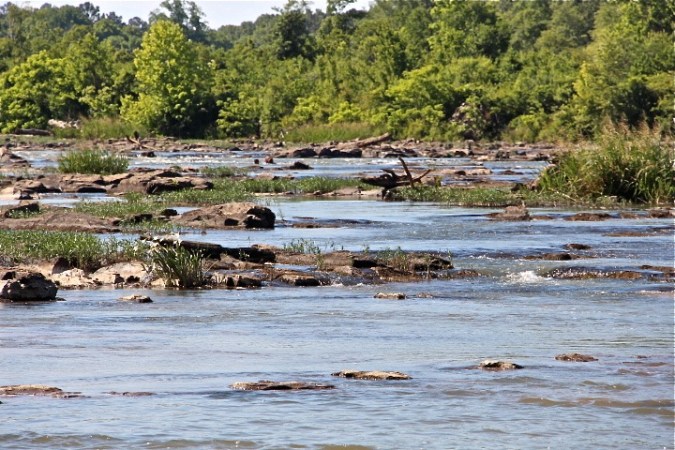
Many times my Mom has spoken of Anthony Shoals as a place prominent in her childhood memories. “It was,” she said, “our beach.” It’s a special place I wanted to see but couldn’t. It didn’t exist anymore.

As a girl, my Mom and her family spent special times there. She remembers quite accurately that the shoals had mountain laurel and rhododendron. They had fish fries and a lot of get-togethers up above the shoals in a place that amounted to a natural campground. Of course there was no electricity but there was a spring that provided water.

As for food, they would pack up live chickens and take everything you needed to cook with, lard, staples, and more. Numerous families would be there. Mom said it was where farming families vacationed after they “laid by.” “They’d take watermelons, cantaloupes … mama took a flour sack of homemade biscuits and we’d haul everything there in a wagon pulled by two mules,” she said.

They would swim and what a joy that must have been on a hot summer day. It seems rustic now but looking back that’s how life was. It’s romantic in the sense that it serves up an idealized view of a difficult time. It was a time when most of the creature comforts we take for granted didn’t exist and that, too, further underscores what a special place Anthony Shoals was. It was in a very real way an oasis. A “beach-like” adventure only I find it better than today’s beaches.

I myself have memories of the place. I remember a fish fry I went to there as a young boy. Three things stand out from that day. The beautiful rock-studded waters, the feeling that this place was special, and how a man scoured a frying pan with river sand until it shone like a mirror. Oddly I have no memory of eating fried fish that day.

All my life I assumed the entire shoals were beneath Clark Hill Lake, and that confused me because I did some math and I should have been too young to remember the place. Still, I had this memory of a place that I didn’t think existed, and I just couldn’t square things in my mind. Clark Hill dam was completed in 1954 and surely the waters had covered Anthony Shoals, but no I was mistaken.

Sometimes it’s great to be wrong. Anthony Shoals still exists. In fact, it’s part of the Broad River Wildlife Management Area. You’ll find rapids at Anthony Shoals, a very long series of rapids of Class II difficulty. You’ll also find a channel cut through ledges so barges from yesteryear could travel upstream. Canoeists and kayakers love the shoals.

Anthony Shoals

What’s not to love? Grassy islets, forest-clad slopes, and a rocky streambed hosting rushing water make for a picturesque setting. And it gets even prettier come spring. Anthony Shoals is the only place on the Broad River that supports the rare shoal lilies that dwell on Southeast fall line rivers. History lives here too. The area also harbors remnants from previous settlements, including Native American mounds and the ruins of old mills and factories from the 1700s.

In researching Anthony Shoals I ran across stunning paintings by Augusta native, Philip Juras. In 1997, he earned a Master of Landscape Architecture degree from the University of Georgia, writing his thesis on the pre-settlement savannas that once flourished across the southeastern piedmont. Philip, who lives in Athens, focuses primarily on remnant natural landscapes that offer a glimpse of the Southeast before European settlement changed so many things. An artist quite often is passionate about his subject matter and so is Philip.

Here’s an excerpt from Philip’s essay in Bartram’s Living Legacy: Travels and the Nature of the South.

“There is no river scene in the Piedmont of northeast Georgia more stunning than Anthony Shoals on the Broad River. Perhaps there used to be. Perhaps the many great shoals on the Savannah River were just as glorious before they fell silent beneath the waters of the Thurmond, Russell, and Hartwell reservoirs, but I’m not quite old enough to have known any of them. Only the rapids above Augusta, my hometown, still show the beauty of the Savannah before it leaves the Piedmont. But the wildness of the river there is diminished by the new mansions looking down from the bluffs and the dams parceling out the flow from upstream. I think that’s why I love Anthony Shoals so much. This final stretch of the Broad, as it runs through the Broad River Wildlife Management Area, is the only place in the upper Savannah River watershed where the sound of a wild river still rises from such a wide swath of bedrock.”

Juras continues commenting on the setting for his splendid painting. “On the evening I captured this view, mountain laurel, snowbells, mock orange, Piedmont rhododendron, and fringe tree were in various states of bloom on the steep slopes next to the river. The main show, however, was being staged on the river itself, where one of the few populations of shoals spiderlilies left in the Savannah watershed was catching the light of the western horizon with glorious full blooms.”

Juras recounts how Anthony Shoals avoided being dammed by two proposed hydropower dams. “Though spared in the 20th century, the shoals have certainly seen human activity before then. If this view had been painted 150 years ago, the Broad River Manufacturing Company would appear on the opposite bank. Its millrace would be visible reaching upstream to the head of the shoals, and in that view much of the forest would have been cleared from the hills. However, if you imagine an earlier time when Native Americans inhabited this area, it’s likely the scene would appear much as it does today.”

The Broad River Manufacturing Company Juras mentions used cotton referred to as “Goshen cotton.” The cotton’s long gone and its gift to us today is some of the more interesting ruins from the nation’s early industrial settlements. Brick walls and towers rise from the forest floor.

Anthony Shoals 2

I find the place fascinating. I plan to go there soon with my camera and laptop. I’ll find a shady spot with a command of the shoals and reflect on all that’s transpired here. I’ll imagine Native Americans gazing at the rare shoals lilies of spring. I’ll watch barges poled and dragged upstream with cargoes destined for merchants in the Piedmont. I’ll see whitewater rushing through the distant mill’s millrace delivering the most natural power imaginable. I’ll watch kids playing as their parents prepare a tremendous picnic. I’ll see an artist painting his beautiful landscapes. Best of all, I’ll take solace in rediscovering a place from childhood, one I thought lay beneath lake waters like so many other long-lost treasures do.

The shoals, by the way, take their name from relatives on my Mom’s side of the family. That’s where my daughter, Becky, gets hers middle name, “Rebecca Anthony Korom.”

And now I discover that people actually pursue rock climbing there on a small group of challenging boulders, several of which have “climbable problems.”

I can’t wait to go there. I’ll spend an afternoon at a place where my Mom spent some of her more memorable childhood days, a jewel of a place that still sparkles.

Heroes of the Soil

My lunches have been simple but delicious all summer. I’ve pretty much lived off tomato sandwiches. I grow my own tomatoes in the back yard. Here in the city we don’t have that much land for planting a garden, so I satisfy my urge to farm in a simple manner: bush tomatoes in one half of an old whiskey barrel. I’m always thinking of other things I’d like to grow. The desire to grow things is one of those instincts hardwired into us. Somewhere along the human highway running from hunter to gatherer, we learned to stay in one place and grow those things that sustain us.

(The way things are going we all may resort to growing our own food soon, but that’s a story for another day.)

Growing up back home, I remember gardens aplenty. We had gardens and I remember mornings spent shelling field peas and butter beans, shucking corn, and chopping corn too. Shelling butterbeans would eventually give you a raw spot on your thumb. And shelling peas wasn’t a joy. I recall how my Dad made a pea sheller from the rolls of an old-fashioned washing machine. It worked though it smashed some peas and sent others flying all over the place.

I don’t recall, however, seeing roadside stands in Lincoln County. Maybe that’s because everyone back then had a garden. I remember for sure my Granddad Poland’s watermelons. I remember how his back porch would be stacked end to end with striped, dark green, elongated melons known, I believe, as a Congo watermelon.

That was then; this is now. Progress keeps changing things. As we become more and more urbanized, as more and more kids grow up far removed from farms, people are losing touch with what it takes to grow things. Fruit and vegetables magically appear. The many convenient ways we get food these days has created a disconnect in the minds of many as to what is actually behind a basket of tomatoes or peaches. And that, of course, is a ton of hard work, but my how the work delights the senses.

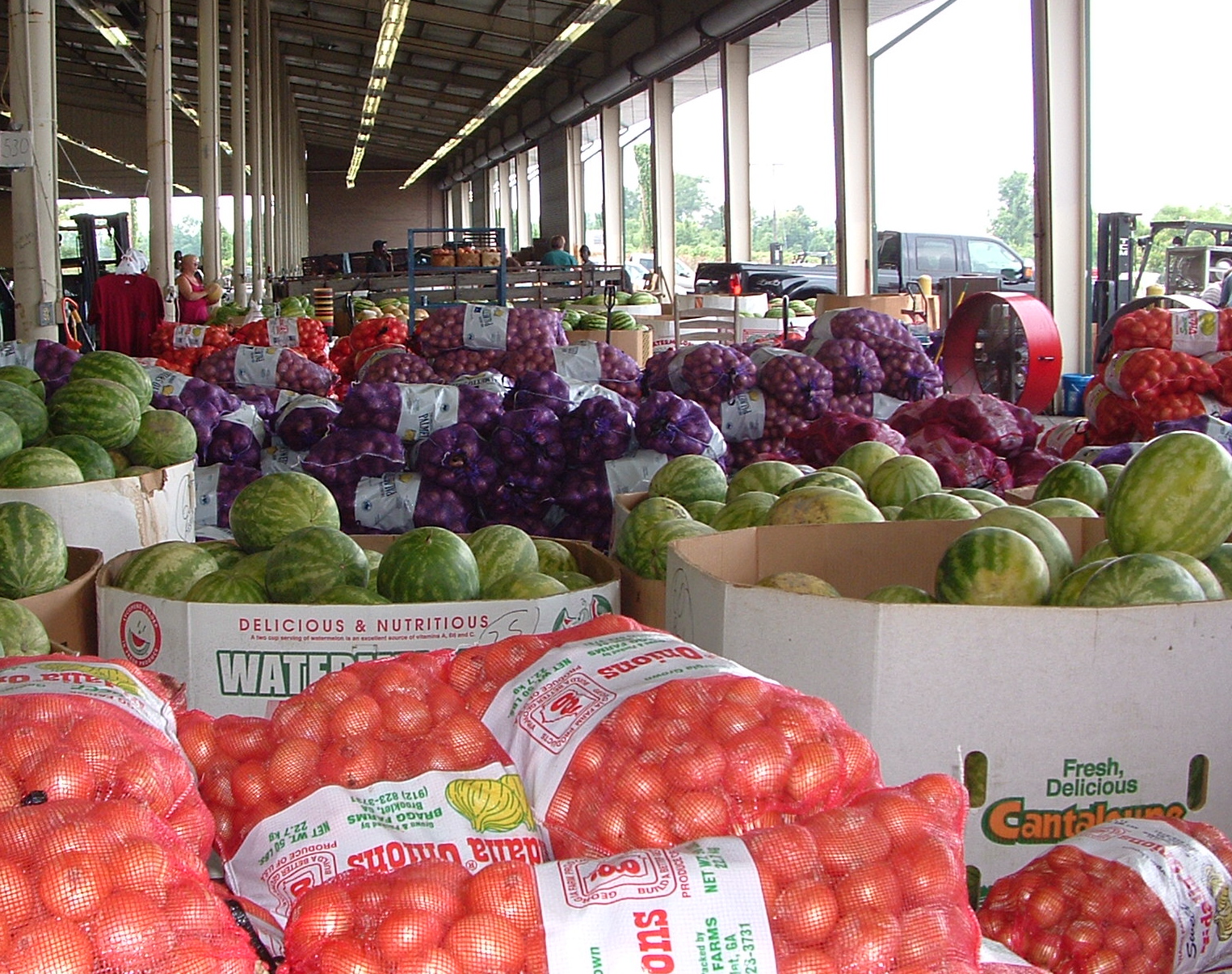
Is there anything lovelier than baskets of fresh peaches or tomatoes? How about ripe, shiny bell peppers? Or what about a basket of purple plums? I love going to grocery stores like Publix and looking at the beautiful produce, but there is a better way to enjoy the labors of farmers. This past Saturday day, my friend, the legendary Trix, and I went to a place that makes grocery store produce look like a bag of dried peas. We drove down to the Farmers Market, a collection of sheds that stands in the shadow of Williams Brice stadium.

Large fans shift the air about here, air that’s strangely sweet. The aroma of fresh vegetables and fruit commingles with the overripe air of discarded produce. It’s a fragrance strangely absent in supermarkets. In fact, supermarket produce has no smell at all.

You’ll find flowers, sod, and an assortment of Southern riches in the Farmers Market that make the summertime delicious to the eyes and taste buds.

I walked around with my camera and soon spied a beautiful stand of crooked neck squash, striped watermelons, purple plums, large pods of okra, and succulent cucumbers. And then, lo and behold, large orange sacks of Vidalia onions appeared. A short, weathered woman overlooking all these riches spied me. She walked over and said, “We’ve got Vidalias.”

She’s got to be a Georgian I figured, knowing that you can’t label onions as Vidalias unless they are the real deal. Sure enough, she’s from Brooklet, Georgia, a rural outpost just outside Statesboro.

There’s something about farmers. They seem the truest, most honest folks on the planet. Talking to her was easy as she loaded us up with a bag of Vidalias, cantaloupes, a nice watermelon, which she slapped several times. “Hear that,” she said. “That’s how it sounds when it’s ripe. Listen,” and she slapped it three more times. “Got seeds, now.”

Next we got a basket of crooked neck squash and as we talked she explained that she stays here all week selling produce grown beneath a Georgia sun. Her husband goes back to the farm and gets another truckload ready for her to sell. Pure teamwork.

I know that the current Farmers Market is destined to close by October. That old bugaboo, progress, aided by politics, is again rearing its often-ugly head. A new and better farmers market is being built over here just off I-26 and I-77 on Highway 321. This new market will feature a restaurant, an RV park, amphitheater, an agricultural inspection station, and will sprawl 2,500 feet of frontage along I-26. It’ll be bigger than seven Super Walmarts. Sort of sounds like a place to go on vacation. “C’mon kids, pile in the car, we’re going to the Disneyland for Collards and Daisies.”

When I asked this Georgia farmwoman from Brooklet what she thought about this new and improved market, worries flooded her face. She’s not sure it’s a good thing. “We got a lot of walk-through traffic here,” she said, “students and poor folks wanting fresh produce. They won’t be able to find us as easily.”

She doesn’t think the new, distant location will draw pedestrians like the quaint old market next to the stadium did. Farming is fraught with risks and anything deviating from a tried and true formula must be eyed with suspicion. The good folks of Columbia, South Carolina, are changing the ultimate destination for her and her husband’s hard work.

Of course, there’s a story behind the story here. Those of you who’ve come to see Georgia play the Gamecocks over here know that their stadium lacks anything even remotely akin to a campus atmosphere. You can circle the entire complex and you’ll spot three trees yielding shade. All three are large oaks and all three are in the Farmers Market. I can show you where some grass is, too, if you really want to know where it is.

For a long, long time the University of South Carolina and its fans have wanted to grab that property. It’ll soon be theirs. And the new Farmers Market? Well, it’ll be a ways down the road, toward Charleston. I’m sure I’ll check it out next summer, but I’m even more certain of something else. Growing my own tomatoes.

Fall and football are just around the corner, but I’m already dreaming of homegrown tomatoes sliced thick and piled on whole wheat bread slathered with mayonnaise, a dollop of sour cream (try it, you’ll like it), and a slab of sweet Vidalia onion. Add a little salt and pepper and it beats a grocery store’s wax tomatoes by a country mile. Sadly for me, it’s as close to farming as I get. There’s something about growing things that makes you a better human being, and this world needs all the good human beings it can stand, not to mention fresh vegetables.

Farming’s a tough way of life that keeps getting tougher. The next time you sit down to a squash casserole, a bowl of beautiful strawberries, or a cool refreshing salad filled with cucumbers and Vidalia onions, send up a special prayer for those true heroes of the soil, Southern farmers.

Georgia Riches Photo by T. Poland